Select a site alphabetically from the choices shown in the box below. Alternatively, browse sculptural examples using the Forward/Back buttons.
Chapters for this volume, along with copies of original in-text images, are available here.


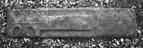
Object type: Grave-cover [1][2]
Measurements: L. 171 cm (67.5 in); W. 38 > 36 cm (15 > 14 in); D. min. 14 cm (5.5 in)
Stone type: Pale yellowish brown (10YR 6/2), moderately sorted, clast-supported, quartz sandstone. The sub-angular to sub-rounded clasts range from fine-grained (0.2 mm) to very coarse-grained (1.5 mm), but are mostly medium- to coarse-grained in the range 0.4 to 0.7 mm. Ward's Stone Sandstone Formation, Millstone Grit, Carboniferous
Plate numbers in printed volume: Ill. 526
Corpus volume reference: Vol 9 p. 205
(There may be more views or larger images available for this item. Click on the thumbnail image to view.)
Set within a roll-moulding border is a hammer-headed cross (type A5), carved in relief, which only occupies the upper two-thirds of the slab. It has a broad shaft and the centre of the head is decorated with an equal-armed cross carved in relief.
The cross on this slab takes the form of a hammer-head in which the upper arm is expanded to the same overall width as the lateral arms. This form of head is one whose geographical distribution, on both crosses and slabs, is centred on the region around the Solway Firth (Collingwood 1922–3, figs. III (13), IV; Anderson 1927, fig. 3; id. 1936, fig. 3; Foster 1958–60, fig. 1; Bailey and Cramp 1988, 31; Cormack 1995, fig. 30 (no. 5); Bailey 1996c; Hill, P. 1997, fig. 10.107 (no. 7); for summaries see Collingwood 1927a, 90–2; Bailey 1980, 182–3). Outside this area there are a few scattered examples from west Yorkshire, Argyll and, in a variant form, south Wales (Coatsworth 2008, 42; Fisher 2001, 22, 40, fig. H(2); Edwards, N. 2007a, 135–9; Redknap and Lewis 2007, 227–30).[3] In free-armed form the extended lower member of the cross-head does not survive, but it is found on the Addingham ring-head in Cumberland, on a shaft at the west Yorkshire site of Gargrave, and on the slabs at Kilmorie and Kilmory Knap in south-west Scotland (Bailey and Cramp 1988, ill. 1; Coatsworth 2008, ill. 278; Collingwood 1927a, fig. 113; Fisher 2001, 40, fig. H(2)). This slab thus links Heysham to the Solway region at a date which, given the decoration of the other occurrences of hammer-heads, must be within the Viking period. Relief crosses at the centre of cross-heads are found again in Lancashire at Colne 1 and in Yorkshire at Burnsall and Dewsbury (Ills. 445; Collingwood 1915, 151, 168; Coatsworth 2008, ills. 106, 229).
[1] The difficulties of distinguishing between the original provenances of sculpture from this site have been emphasised by recent excavations (Potter and Andrews 1994, 104, and fig. 2). The following list therefore combines material from both St Peter's church and St Patrick's chapel.[2]
[2] The following are general references to the Heysham stones: Robson 1850, 28; Jackson 1889, 33; Allen 1894, 4, 8; Micklethwaite 1898, 348–9; Taylor, H. 1898, 42; Howarth 1899, 9, 21; Nicholson 1899, 21; Grafton 1904; Ditchfield 1909, 117; Grafton 1909; Farrer and Brownbill 1914, 110; (–––) 1923, 288; Curwen 1925, 30; Collingwood 1927a, 15; Hogarth 1934; Bu'lock 1972, 67; Fellows-Jensen 1985, 402, 405; Crosby 1998, 30; Higham, N. 2004a, 27; Blair 2005, 216, 218, 309, 376, 457; Salter 2005, 42; Newman, R. M. 2006, 103.
The following are unpublished manuscript references: BL Add. MS 37550, items 617–46, 735–6; BL Add. MS 37551, items 72–5; Lancaster Public Library, no. PT 7; Manchester Public Library, Hibbert Ware S. MSS: Msf 091 H21, V, 64 (no. 5), 82 (no. 1); vol. 8, 98v. For the Hibbert Ware collection see Henry and Trench-Jellicoe (2005, 239–60).
[3] A recently discovered fragment from Rochdale adds another example to this list (see p. 000).
