Select a site alphabetically from the choices shown in the box below. Alternatively, browse sculptural examples using the Forward/Back buttons.
Chapters for this volume, along with copies of original in-text images, are available here.


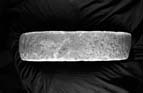
Object type: Round-headed grave-marker with shaft, in two pieces [1]
Measurements: H. 84 cm (33 in); W. 53.5 > 39 cm (21 > 15.4 in); D. 12 cm (4.7 in)
Stone type: Sandstone, pale yellow-buff, quartz-cemented. Quartz, feldspar with sparse mica and white kaolinite pore-fills. Local Millstone Grit Group. [G.L.]
Plate numbers in printed volume: Ills. 784-6
Corpus volume reference: Vol 8 p. 271-2
(There may be more views or larger images available for this item. Click on the thumbnail image to view.)
The surface is quite well dressed to a smooth, flat surface. The round, plate-like head was originally carved in one block with the shaft, which is completely plain.
A (broad): The head is marked out by two concentric incised circles. Within these two circles, at the top, are three incised pendant triangles, the central one shorter than the outer two: these may represent an attempt at zigzag decoration. Within the central circle, incised zigzags, two straight lines, and one apparently compass-drawn curve partly define a central oval, possibly intended to be a central circle. The centre is blank where it is not damaged.
B and D (narrow) and E (top): Plain
C (broad): The opposite face is defined by one incised compass-drawn circle, of which the punched centre still survives. Within this, four compass-drawn semi-circles define a cross-shape with very broad side arms and narrow upper and lower arms: roughly type B10, although decoration within this shape (incised part-circles which cut each other and have a pseudo-plait-like appearance), also make it more like the odd, five-armed figure on Adel 4C below (Ill. 792).
Appendix A item (Stones dating from Saxo-Norman overlap period or of uncertain date)
Monuments of such simple form and decoration are notoriously difficult to date. However, the grave-markers from this site all seem to conform to a type thought to belong to the late eleventh century, the period of Saxo-Norman overlap. All have a rounded, plate-like head and are thin and flat in cross-section.
There are monuments of comparable form from Birtley and Chollerton in Northumberland (Cramp 1984, pls. 234.1325–7 and 236.1335–6), and from Barningham in northern Yorkshire (Lang 2001, ills. 1132–6), although I know of none with similar incised decoration. Adel has a very fine Norman church, and there seems no suggestion of an earlier building. The architectural sculpture at the church is very elaborate, which makes the apparent crudity of these pieces something of a puzzle.
