Select a site alphabetically from the choices shown in the box below. Alternatively, browse sculptural examples using the Forward/Back buttons.
Chapters for this volume, along with copies of original in-text images, are available here.


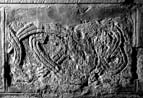
Object type: Fragment possibly of a shaft
Measurements: H. 47 cm (18.5 in); W. 25.5 cm (8.9 in); D. Built in
Stone type: Fine-grained cellular dolomitic limestone. Colour very pale brown (10YR 8/3). Local to the site, much of the church is built of similar material. Brotherton Formation (Upper Magnesian Limestone), Upper Permian. [J.S.]
Plate numbers in printed volume: Ill. 722
Corpus volume reference: Vol 8 p. 265-6
(There may be more views or larger images available for this item. Click on the thumbnail image to view.)
A flat border survives on one edge, the lower edge as it appears in its present position. The decoration consists of a twist in a fine triple strand, leaving large open areas of background. On the right is a terminal but this is now more worn than it apparently was when drawn by Collingwood (1915a, fig. on 248). It may nevertheless be as he drew it, a Stafford Knot (simple pattern E). The strands then glide to lace through what appears to be the beginning of a loose ring on the (now) left-hand edge. Before this, one triple strand twists to form a broken loop inside the glide. Collingwood drew it as a complete loop and the other triple strand as damaged but forming a comparable inward-facing loop: this last detail is now impossible to confirm.
This is the same stone type as the fragment at nearby Wighill, with which it shares some design features (p. 269, Ills. 766–8). It is unfortunate that both pieces are relatively small fragments of which only one face is visible, but both appear to be attempting to convey a sense of a more complex interlace pattern in a fairly crude form.
