Select a site alphabetically from the choices shown in the box below. Alternatively, browse sculptural examples using the Forward/Back buttons.
Chapters for this volume, along with copies of original in-text images, are available here.


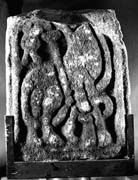
Object type: Part of shaft
Measurements: H. 45 cm (17.7 in); W. 32.7 > 32 cm (12.8 > 12.6 in); D. 18.6 > 18.3 cm (7.3 > 7.2 in)
Stone type: Not seen by geologist: 'coarse sandstone' (Heginbottom 1988, 4)
Plate numbers in printed volume: Ills. 717-20
Corpus volume reference: Vol 8 p. 253
(There may be more views or larger images available for this item. Click on the thumbnail image to view.)
This was first identified and photographed by R. C. Cross in 1975; and first published by Faull (1981, 210, 221–2 fn. 10, pl. VIB), on information from P. H. Thornberrow of the West Yorkshire Archaeology Unit. It was found built into the internal gable of the wall dividing the barn from the house at Lower Bean Hole Head Farm, 400 metres east of a settlement called Cross Stones, and was removed on the conversion of the barn to a dwelling.
There is some argument as to whether this could have been the stone referred to in Watson (1775, 281) who said the settlement took its name 'from an antient stone cross, the top of which is now destroyed, and the bottom is made into a seat, from whence a very good prospect of the county'. Newell (1928, 171–4) recorded some contradictory local recollections of the whereabouts of this stone, and also noted that the Hebden Bridge Chronicle in 1855 stated that the stone, described as a socket, and known as the 'Priest's Chair' had been removed to Stansfield Hall. Newell, Heginbottom (1988, 2–4) and others searched the grounds of the Hall for any trace of this stone without success. The doubt as to whether this was the same stone arises because the barn is said to have been built in 1701 (Heginbottom 1988, 2).
Part of a cross-shaft of rectangular section. The angles are squared. The carving is not deep, but the degree of modelling varies from face to face, with the flattest carving on face C in which the least amount of ground is also visible. On the other faces, the ground is chiselled flat.
A (broad): This face has an outer flat and inner roll moulding at the sides, and though rather worn these two frames are probably also present on the lower edge. The panel has a quadruped facing right, but with the curve of its long neck showing that its missing head was probably backward-turned. Its tail wraps around behind its rear legs, along its underbelly and the underside of its neck, and it is presumably this which returns across its body to entangle the creature's forelegs. In the top left corner is a long-jawed and domed head, which could be of the same animal although it appears rather small.
B (narrow): There is a flat moulding on the edges and a flat divider below each of the three small panels. (i) Too little remains of the upper panel for identification. (ii) This has a sinuous animal form constrained by the square panel. It represents a creature with its small head in the top right corner, and a foreleg which extends into the bottom right, then turns up in a double curve to end in a foot (a hoof?) against the right panel edge. Its back is bent to fit the top left corner, below which is the swelling for its haunch, which terminates on the lower edge in an exaggerated foot. (iii) This contains a small plump bird, its head with down-turned beak to the left and tail on the right. It stands on a small mound.
C (broad): Flat outer and inner roll mouldings as on face A. The ground is almost completely filled by one register of interlace, a form of surrounded half pattern C, with a broad flat strand.
D (narrow): The same mouldings as faces A and C. The decoration is a simple continuous twist, rather more modelled than the strand on face C and with more background, chiselled flat as on A and B.
The animal on face A is a quadruped involved in and fettered by interlace produced from its own tail, an Anglian type which in this form is particularly reminiscent of Mercian work (cf. an example from St Alkmund's, Derby: Lang 1978b, fig. 8.3A), but which also achieved some popularity in west Yorkshire: see for example Ilkley 3 (Ills. 361–4) and the later Otley 3 (Ills. 579, 581). The isolated animals on face B look like Scandinavian-period taste: compare Brompton 3 and Kirklevington 3 in north Yorkshire (Lang 2001, ills. 39, 408). However, the strange distorted little creature in panel Bii is a reminder that the isolation of lively animal forms, shaped to fit a space, began in the pre-Viking period: see for example the animal in panel Ciii of the Cundall/Aldborough shaft (Lang 2001, ill. 162). See also Chap. V, p. 58.
