Select a site alphabetically from the choices shown in the box below. Alternatively, browse sculptural examples using the Forward/Back buttons.
Chapters for this volume, along with copies of original in-text images, are available here.


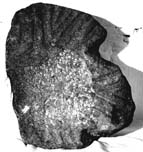
Object type: Part of cross-head
Measurements: H. 36 cm (14.1 in); W. 28 cm (11 in); D. 13 > 6 cm (5.1 > 2.4 in)
Stone type: Millstone Grit (B. Fuller, pers. comm.)
Plate numbers in printed volume: Ills. 701-3
Corpus volume reference: Vol 8 p. 252
(There may be more views or larger images available for this item. Click on the thumbnail image to view.)
The form of the head cannot completely be determined, but it had curved armpits. A head of type B10 is not improbable.
A (broad): The head has at its centre a large central boss surrounded by a roll moulding. Triple roll mouldings outline the upper and side arms.
B and D (narrow): Completely broken away
C (broad): The central boss has been hacked off. The side arms are the same as on face A.
The triple mouldings suggest that this cross-head could be part of Stanbury 1, or a very similar shaft, and the dimensions of the pieces also suggest this possibility. Professor R. N. Bailey has suggested that the strange decoration represented a '(geographically) widespread simplification of knotwork and scroll patterns which occurs in the tenth and eleventh centuries', and cited as parallels a head from Walton, Cumberland (Bailey and Cramp 1988, no. 1, ills. 573–6), a shaft from Burton in Kendal, Westmorland (ibid., no. 3, ills. 189–92), and a head from Wooler, Northumberland (Cramp 1984, no. 1, pls. 229.1292–5).[1] The pattern extending into the shaft on Stanbury 1 bears some resemblance to a type of ornament found on work of the eleventh to twelfth century, in which the concave-sided lozenge-shaped spandrels between the semi-circles are also embellished with extra mouldings (see for example a grave-cover from Oxford, in Tweddle et al. 1995, 233, ill. 362; Blair 1988, 266-8, fig. 105). However on Stanbury 1, the decoration seems to arise as a development from the triple mouldings in the head, with embellishment of the resulting spaces. Such simplification, however, as suggested above, seems to have risen already in the pre-Conquest period, and the form of the cross-head suggests the earlier date.
Stanbury 2 appears to be almost identical to a more complete head recently re-discovered at East Marton, but which came from Colne in Lancashire originally, however (see Bailey forthcoming). The Colne cross-head suggests that it and Stanbury 1 and 2 are a local version of the late Anglian free-armed head. Its closest parallels, I would suggest, would indeed seem to be in Cumbria, where I would also cite Kirkby Stephen 6 which Bailey explicitly related to his 'spiral-scroll school' (Bailey and Cramp 1988, 124, ill. 410).
