Select a site alphabetically from the choices shown in the box below. Alternatively, browse sculptural examples using the Forward/Back buttons.
Chapters for this volume, along with copies of original in-text images, are available here.


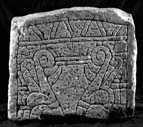
Object type: Incomplete grave-marker [1]
Measurements: H. 50 cm (19.7 in); W. 57 cm (22.5 in); D. 10.5 cm (4.1 in)
Stone type: Fine grained well sorted sandstone having a light brown body colour (10YR 6/4), bedding planes present with dark brown staining (10YR 3/3). Stone provenance as Otley (All Saints) 1. [J.S.]
Plate numbers in printed volume: Ills. 606-7
Corpus volume reference: Vol 8 p. 226-7
(There may be more views or larger images available for this item. Click on the thumbnail image to view.)
One end of a slab, probably a grave-marker. The end is rounded in a shallow curve and the carved area has an incised border which follows the outline of the slab so that the end also has a shallow curve. The decoration is all incised. Only one face is carved: the edges are plain.
A (broad): The end of the carved area has a narrow border, separated from the main part by a double incised line. Within the border are three blunted chevrons or V-shapes, each double outlined. The remainder of the slab has an incomplete ornament of a debased Ringerike style, incorporating two pairs of the curling tendrils associated with this style. The inner tendrils are joined by three parallel incised lines, while three double incised lines connect the outer tendrils to the frame.
Fuglesang (1980, 191) suggests that the motif represented is probably part of an equal-armed, floriate cross as on a slab from the City of London (Tweddle et al. 1995, 228–9, ill. 353). She noted, however, that some aspects of the style — the straight lines joining the pattern elements to the frame, and the pattern of the upper border — are untypical of designs in the Ringerike style with a Scandinavian provenance, and this less than classic configuration contrasts with the London pieces, highlighting the provincial nature of the Otley slab. The spread of the Ringerike style is so rare outside the London area, that even in this adapted and assimilated form this stone speaks volumes for the connections of eleventh-century York.
The Ringerike characteristics of this piece were first identified by Brøndsted (1924, 294–5). See also Otley 11.
