Select a site alphabetically from the choices shown in the box below. Alternatively, browse sculptural examples using the Forward/Back buttons.
Chapters for this volume, along with copies of original in-text images, are available here.


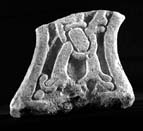
Object type: Part of cross-arm [1]
Measurements: H. 18 cm (7.1 in); W. 21.5 (at end of arm) > 15 cm (8.5 > 5.9 in); D. 11.5 cm (4.5 in)
Stone type: Sandstone, clean, buff-brown colour, fine to medium grained, quartz with subordinate feldspar grains, slightly micaceous. The margin of the arm fragment is reddened by burning. Upper Carboniferous, could be either Pennine Coal Measures or Millstone Grit Group, Addingham Edge Grit? [G.L.]
Plate numbers in printed volume: Ills. 601-5
Corpus volume reference: Vol 8 p. 225-6
(There may be more views or larger images available for this item. Click on the thumbnail image to view.)
The end of one arm of a cross-head of type B9 or E9. The end is plain and both faces have flat edge mouldings. The style of carving is also flattish and shallow with just some modelling of the edges of the carved area. The background is dressed flat.
A (broad): Collingwood (1915a, 226) described this face as having a 'dragon plait' but it is not certain that the terminals of the strands represent either the heads or feet of animals. The two major strands which cross near the inner end of the fragment terminate at the outer edge in loose fronds, of which one (which crosses another) ends in a curling tip. The same strand appears to terminate in a similar form at the end. These two strands are caught up by a narrow lacing strand, one end of which terminates against the upper border, while the other continues towards the centre of the cross.
B (narrow): Missing
C (broad): A flat strap interlace, on which the crossings of the strands are scarcely marked, fills the end of the arm. If the strands had been painted to show the crossings, the interlace would have ended in a Stafford Knot (simple pattern E).
D (narrow): Plain
E and F (above and below arm): Plain
This is very different from the preceding pieces. The decoration which Collingwood drew as animal ornament looks more like the termination of some Ringerike-style plant ornament. This style, while exceedingly rare in the north of England, has long been recognised on the grave-slab, Otley 12. Here the style is on a free-armed head in the Anglian tradition, so its appearance here is an example of the falling together of late Anglian and Scandinavianised taste. Ringerike style dates to after the period of the Viking kingdom of York, so that it represents fashionable taste and the influence of southern English art in the late pre-Conquest period.
