Select a site alphabetically from the choices shown in the box below. Alternatively, browse sculptural examples using the Forward/Back buttons.
Chapters for this volume, along with copies of original in-text images, are available here.


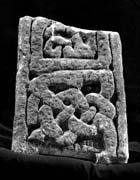
Object type: Part of shaft [1]
Measurements: H. 29.4 cm (11.5 in); W. 26.5 > 23 cm (10.4 > 9 in); D. 14 > 11.5 cm (5.5 > 4.5 in)
Stone type: As Otley (All Saints) 3
Plate numbers in printed volume: Ills. 583-6
Corpus volume reference: Vol 8 p. 221-2
(There may be more views or larger images available for this item. Click on the thumbnail image to view.)
The edge mouldings are rounded on all faces. Pattern strands on all faces are rounded and deeply cut.
A (broad): There are the remains of two panels. (i) The upper is incomplete at the top and has irregular interlace or twist inside a broad inner border which survives on two sides and below. This border is not quite horizontal at the bottom but curves down to a point at the left, and the left side also curves inwards quite markedly near the top. It may be an element of a pattern rather than a frame but this cannot now be ascertained. (ii) The lower has interlace with a bar terminal at the top, and below one horizontal register of simple pattern F (a Carrick Bend). Strands emerge from this in position to form another register below, but a detached strand to the left of the Carrick Bend shows that this is not perfectly managed, regular interlace.
B (narrow): A continuous simple scroll of which three volutes and part of a fourth survive. Each volute ends only in a curling clubbed tip, though drop leaves of a hollow pointed form depend from the outer edge of each volute and fill the spandrels.
C (broad): This face appears to have a double-stranded twist, lacing though double-stranded loose rings. At one point on the right one of the strands forms what looks at first glance like a regular Stafford Knot (simple pattern E) but one strand stops abruptly and there are other points in which the twist is discontinuous. There is some irregular infilling above and to the left of the Stafford Knot.
D (narrow): There is one register of half pattern F from which strands emerge above and below, at the top to link with what may be the start of another register.
The panelled layout, and the controlled, if simplified, plant-scroll suggest a deliberate attempt to recreate an earlier Anglian style (like Otley 6 below (Ill. 592), which has a very similar plant-scroll), in this respect at least looking back to earlier Otley works. In its rather irregular twist incorporating loose rings on face C, it also has something in common with fragments from Thorp Arch and Wighill (Ills. 722, 766–8). A somewhat more, but still not completely, regular version of this pattern is found on the two 'Giant's Grave' crosses from Penrith, Cumberland, nos. 4C and 5B, which Bailey and Cramp (1988, 136–8, ills. 493, 502) associated with the tenth-century Whithorn school on the basis of this pattern (Collingwood 1927, figs. 82–5). This seems a helpful comparison for this piece, in view of other Norse-Irish influences noted in the West Riding.
