Select a site alphabetically from the choices shown in the box below. Alternatively, browse sculptural examples using the Forward/Back buttons.
Chapters for this volume, along with copies of original in-text images, are available here.


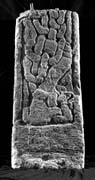
Object type: Lower part of shaft [1]
Measurements: H. 60 cm (23.6 in); W. 29.4 > 25.8 cm (11.6 > 10.2 in); D. 16 > 15 cm (6.3 > 5.9 in)
Stone type: Medium grained Millstone Grit, sub-angular grains including alkali feldspar clasts. Colour very pale brown (10YR 7/4). Stone provenance as Otley (All Saints) 2. Very skilfully cut using point work dressing techniques. [J.S.]
Plate numbers in printed volume: Ills. 579-82
Corpus volume reference: Vol 8 p. 221
(There may be more views or larger images available for this item. Click on the thumbnail image to view.)
The shaft has rounded edges on all faces, and is also very shallowly carved without modelling. The piece appears to represent the base of the shaft with a plain area at the bottom on all faces. There is no trace of panel division on any face.
A (broad): The combination of broad and narrow strands suggests that this is a panel of irregular animal interlace, and in fact there is a dog-like head in the upper left corner and its hindquarters are at the bottom of the panel to the left. It has ear lappet, leg and tail extensions involved in interlace.
B (narrow): An irregular interlace, based on the theme of a continuous half-pattern, perhaps meant to be half pattern C.
C (broad): This face has the same animal as on A, in a better preserved state. Its head is in the top left corner. It has a nick in its upper jaw and an incised oval eye. Its head and long neck and its body form two strong diagonals from one side of the face to the other, leaving three areas filled with irregular interlace developed from its ear lappet. Its foreleg, tangled in interlace, lies along the right-hand side of the shaft; its hindquarter is outlined and its hindleg is tucked below its body, which is also entangled in interlace.
D (narrow): A continuous close-packed four-strand plait, markedly regular in comparison with the other faces.
Kendrick (1941b, 127–8) saw this shaft as an example of 'the maximum Jellinge influence on an English monument' on the basis of its animal ornament. However, the incomplete example of an animal interlocked in bands developed from its own limbs and ear lappet represented on face C (and perhaps on face A) has no double-outlining or spiral joint which would confirm a direct Scandinavian influence: rather it seems, like much of the animal ornament in York and eastern Yorkshire, to stand in a tradition which goes back to early Hiberno-Saxon manuscript decoration; and even the 'beast-chain' form probably represented here appears to have English origins (see Lang 1978b, 149, fig. 8.3). It is also notable that at this site we have already seen an exotic animal on face C of Otley 2 becoming adapted to Anglian taste on face A of the same cross, and even more on face B, in the direction of entangled animals seen here (see Chap. V, p. 57). The design would nevertheless appeal to the Scandinavian taste in the tenth century. This is the only certain example of the interlocked animal/beast chain in the West Riding. Its York connections are perhaps not surprising in an estate of the archbishops of York (Chap. II, p. 19). Nevertheless, the garbled half-pattern on face B looks like an attempt at earlier, local Anglian styles.
