Select a site alphabetically from the choices shown in the box below. Alternatively, browse sculptural examples using the Forward/Back buttons.
Chapters for this volume, along with copies of original in-text images, are available here.


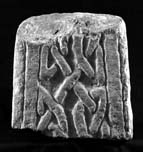
Object type: Part of shaft [1]
Measurements: H. 24.1 cm (9.5 in); W. 24 > 22 cm (9.5 > 8.7 in); D. 17.8 > 16.5 cm (7 > 6.5 in)
Stone type: Sandstone, pale buff-coloured, medium-to coarse-grained, quartzose with feldspars, with polished ferruginous granules on broken surface. Lower Coal Measures Group, Carboniferous (Local Grenoside Sandstone?) [G.L.]
Plate numbers in printed volume: Ills. 452-5
Corpus volume reference: Vol 8 p. 191
(There may be more views or larger images available for this item. Click on the thumbnail image to view.)
A small section of a cross-shaft, the angles rounded but the faces edged with flat mouldings between incised lines. The carving is shallow, but the surface of the strands and the background has been dressed and the edge of the strands is still sharp.
A (broad): One incomplete register of turned pattern C, executed in a flat narrow strand leaving plenty of exposed background. The border on the left is broader than on the right. This face was obscured by plaster when Collingwood drew it.
B (narrow): This has the terminal of a twist, possibly a four-strand twist, in the same flat, open style as face A. The side is incomplete in width and there may have been a further pattern element on the right. Below the decorated area the surface is dressed plain but the double moulding on the left continues to the bottom of the stone.
C (broad): Dressed away
D (narrow): The mouldings on the right echo those to the left of face A. The damage on the left has resulted from the dressing away of face C. The edge mouldings continue to the bottom of the stone. The upper half has the terminal Stafford Knot (simple pattern E) of a narrow panel of interlace or twist.
Although the style is flat with no trace of modelling and the carving is shallow, the piece is also competently carved, especially compared to Kirkheaton 1, and the patterns and remains of layout are all recognisable Anglian pre-Viking types. The layout and style of carving compare closely with Thornhill 2 (Ills. 728–31), which also has interlace on all surviving faces and a similar angularity on face A.
