Select a site alphabetically from the choices shown in the box below. Alternatively, browse sculptural examples using the Forward/Back buttons.
Chapters for this volume, along with copies of original in-text images, are available here.


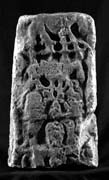
Object type: Incomplete shaft [1]
Measurements: H. 42 cm (16.5 in); W. 24 > 21 cm (9.5 > 8.2 in); D. 14 > 11.5 cm (5.5 > 4.5 in)
Stone type: Sandstone, pale brown, medium- to coarse-grained, hard, quartz-cemented. Lower Coal Measures Group, Carboniferous (Local Grenoside Sandstone?) [G.L.]
Plate numbers in printed volume: Ills. 448-51
Corpus volume reference: Vol 8 p. 190-1
(There may be more views or larger images available for this item. Click on the thumbnail image to view.)
An incomplete cross-shaft of tapering rectangular section. The angles, now all quite worn, appear to have been rounded. Face A has three panels, or at least three registers of figural and animal ornament since there are no panel dividers. All other faces show continuous interlacing ornament. The style is modelled, with rounded strands, and more deeply carved than Kirkheaton 3 and 4.
A (broad): (i) A horse-like quadruped faces right, details of its head now very worn, its legs fettered in a strand possibly extending from its tail. (ii) Below is a second quadruped facing in the same direction, its limbs similarly entangled. In this case at least one knot is visible in the entangling strand, beneath the animal's head. (iii) Below this scene, also now more worn than in Collingwood's drawing, appears to be a group of some kind, but the remains are hard to reconcile with his drawing (1917, fig. on 214, repeated 1929, 43, fig. i) in which is shown, at the bottom, the head and shoulders of a nimbed frontal figure with palm-like plant forms on both sides, which in the reconstruction appear to be carried by the figure. Collingwood also drew a twist on the left. However, the plant on the left looks more like an inward facing figure, while the plant on the right could be another figure, or an animal disposed vertically. Between them, there is in the centre the object Collingwood drew as a large frontal human head. It is impossible to say what this is: there is no trace of the nimbus he saw. The vestiges Collingwood drew as the shoulders of this figure could in fact be a lower border of the panel with another scene below, the central element of which might indeed be a head with a dished halo.
B (narrow): This is a very interesting panel which Collingwood drew with two registers of half-pattern F with outside strands continuing into further registers above and below. Although the registers are more worn and also slightly more distorted than in his drawing, his analysis of the pattern is right.
C (broad): Three complete registers of simple pattern E with further incomplete registers above and below.
D (narrow): Although the strands are still rounded and quite deeply modelled, this is very worn. As Collingwood drew it, it incorporates two loose rings, but in fact the worn strands seem to form two registers of closed-circuit pattern F, with traces of further registers above and below.
There is a strong appeal to Anglian tradition in this shaft. If the vestiges of the lowest panel show a figure with the dished halo at the lower edge, this is surely reflecting the continued importance of this type with its earliest appearance on Otley 2 (Ills. 577–8). It is disappointing that the apparently figural panel at the centre of this face is impossible to interpret. The animals with extremities involved in interlace must also be a reflection, though a rather weak one, of the beasts on crosses such as Ilkley 2 and especially Ilkley 3 (Ills. 357–60, 361–4). The interlace patterns are also a passable expression of Anglian interlace but the units are not regularly gridded, and the strand sometimes varies clumsily in width. The carver was ambitious, however, especially on faces B and D, and may have been using worn or distorted templates. The loose ring elements shown by Collingwood'seem to be products of wear, as there is no trace of any direct Scandinavian influence in style or motif. It is a particular pity that in their present state any figures on face A are irrecoverable.
