Select a site alphabetically from the choices shown in the box below. Alternatively, browse sculptural examples using the Forward/Back buttons.
Chapters for this volume, along with copies of original in-text images, are available here.


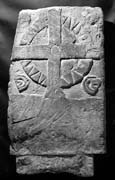
Object type: Grave-marker [1]
Measurements: H. 90 cm (35.5 in); W. 51 cm (20 in); D. 14 cm (5.5 in)
Stone type: Oolitic limestone (ibid.)
Plate numbers in printed volume: Pls. 525-6
Corpus volume reference: Vol 7 p. 236-7
(There may be more views or larger images available for this item. Click on the thumbnail image to view.)
This rectangular slab is carved on the two broad faces.
A (broad): At the top is a circle-headed cross, carved in low relief; the arms are type B1 with an incised circle in the centre. The ring is decorated with pellets enclosed in flat-band mouldings, and the spandrels of the arms are filled with scooped 'leaves'. On either side at the base of the head are the worn remains of rosettes which appear to have been originally attached to the ring. There are vestiges of what may have been similar features on either side at the top.
B (narrow): Broken and plain
C (broad): The bottom section of the face has been chiselled away, but above is a ring (b) cross-head in low relief. The cross, type A1, is plain with an incised circle in the centre and possibly on the lower arm; the ring is incised with zigzags. Outside the ring at the base are features composed of triple U-shaped rings.
D (narrow): Plain
Appendix A item (stones dating from Saxo-Norman overlap period or of uncertain date).
Despite the fact that this piece has been very damaged by later reuse, it is possible to see that it was a grave-marker of some pretension, in contrast for example to Shaftesbury 2–4 (Ills. 92–4). The head of a cross from St John Walbrook in London (Tweddle et al.1995, ills. 347–9) throws some light on this original piece, since rows of pellets, zigzags, and the ring head with simple A1 type cross are all there present. Head shapes such as these, which are intermediate between ring heads and plate heads, are usually assigned to a late date in the series, and the London piece is given an eleventh-century date, as Tweddle admits, on 'very insubstantial evidence' (ibid., 225).
Nearer at hand there is a resemblance, in the rosettes with drilled dots in the tips of the petals and also the scooped infilling leaves, to the piece from Whitchurch Canonicorum, Dorset (Ills. 160–1), which likewise is difficult to date. Rosettes can be seen as a late feature, but attached to the cross as here can be interpreted as hanging wreaths for dressing the cross, such as one finds on Escomb 7, co. Durham (Cramp 1984, 79, pl. 55, 271). The ambiguity of the ornament is further expressed in the U-shaped features on the opposite face, which are reminiscent of the domed 'clips' which are such a feature of late Saxon plant ornament in Wessex (see introduction, pp. 51–4). A date in the eleventh century whether before or after the Conquest is therefore possible.
