Select a site alphabetically from the choices shown in the box below. Alternatively, browse sculptural examples using the Forward/Back buttons.
Chapters for this volume, along with copies of original in-text images, are available here.


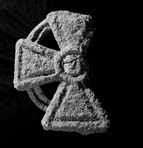
Object type: Cross-head
Measurements: H. max. 42 cm (16.5 in); W. 25 cm (10 in); D. of arms c. 10 cm (4 in); H. of lower arm 17 cm (6.5 in); W. of smaller arm 14 cm (5.5 in); Diam. of boss 10 cm (4 in)
Stone type: Yellowish grey (5Y 8/1) on fresh fracture, but 5Y 7/2 on weathered surface, medium- to coarsegrained, clast-supported, bioclastic limestone. Clasts range from 0.4 to 3.0 mm, but mostly fall in the range 0.6 to 1.5 mm. The clasts are sub-angular to sub-rounded; some are broken and show a characteristic calcite rhomboidal fracture. There is a very crude alignment of clasts paralle to the long axis of the stone. Doulting stone, Upper Inferior Oolite Formation, Inferior Oolite Group, Middle Jurassic
Plate numbers in printed volume: Pls. 255-7
Corpus volume reference: Vol 7 p. 158-9
(There may be more views or larger images available for this item. Click on the thumbnail image to view.)
A and C (broad): Both faces are identical, consisting of the upper and lower arms and one horizontal arm of a wheel-headed cross, type B6. In the centre of the cross is a flattened boss surrounded by a roll moulding. The wedge-shaped arms are also outlined by a shallow roll moulding and an inner groove. The ring, which is 4 cm wide, also has a shallow median groove.
At the base of the lower arm a small section of the shaft survives.
Rahtz dated the phase from which the head derived to the late Saxon/early medieval period within the context of a monastic site, and also considered that there was a cross-base on the summit which might have been the original location of this cross (Rahtz 1970, 22, 30). This piece could have been the capping for a cross, about 155 cm (60 in) high as Rahtz suggests (1993, 60–1), or a head or footstone as Radford suggested as an alternative (Rahtz 1970, 48). If the former, the crosses at Lindisfarne, Northumberland, nos. 45 and 46 (Cramp 1984, 243–4, pls. 245, 1361 and 246, 1364) which have been dated as possibly eleventh century are a good parallel; or if the latter, grave-markers from Whitby, Yorkshire (Lang 2001, 288–9, ills. 1168–1179). A grave-marker from the Old Minster which has been dated 'mid to late eleventh century' (Tweddle et al. 1995, 337: Winchester 92, ills. 692–3) seems a later type: the arms are wedgeshaped but more squat, the boss is flatter and it is a circle head, rather than a ring type (a), merging into a type which is carved from a solid block, like Chollerton, Northumberland (Cramp 1984, 237–8, pl. 236, 1335). On the whole a date in the eleventh century seems reasonable for this piece, and since this is a delicate carving and there is a long tradition of ring-heads in Wessex (see Amesbury 1, Ills. 383–7, and Fig. 18, p. 36) it is most probably pre-Conquest.
