Select a site alphabetically from the choices shown in the box below. Alternatively, browse sculptural examples using the Forward/Back buttons.
Chapters for this volume, along with copies of original in-text images, are available here.


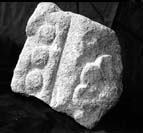
Object type: Architectural fragment
Measurements: H. 11 cm (4 in); W. 12 cm (4.5 in); D. 4.5 cm (1.75 in)
Stone type: Pinkish grey (5YR 8/1), medium-grained, poorly sorted, clast supported, bioclastic limestone. Clasts sub-angular to sub-rounded. Clasts vary from 0.3 to 0.6 mm, with a few up to 1.0 mm. Doulting stone, Upper Inferior Oolite Formation, Inferior Oolite Group, Middle Jurassic
Plate numbers in printed volume: Pl. 358
Corpus volume reference: Vol 7 p. 183
(There may be more views or larger images available for this item. Click on the thumbnail image to view.)
A: Only one face is carved. On one side a double moulding enclosing a line of pellets, and at a slight angle five indented petals forming part of a rosette with a raised centre. All other sides are cut away.
Appendix A item (stones dating from Saxo-Norman overlap period or of uncertain date).
This is only a tiny fragment, the form of which could have been originally architectural. Pelleted borders and rosettes occur in both Anglo-Saxon and Romanesque art and it is difficult to date this fragment. There is a rosette of a different form on a Bath crosshead (no. 6, Ill. 178), and, as Foster points out (1987, 60), rosettes as parts of medallions are common in late Saxon manuscripts (see Ill. 527).
Glastonbury 14 (see below) could well be part of the same feature, despite the slight variation in stone type, and if so this is valuable evidence for architectural decoration on this important site.
