Select a site alphabetically from the choices shown in the box below. Alternatively, browse sculptural examples using the Forward/Back buttons.
Chapters for this volume, along with copies of original in-text images, are available here.


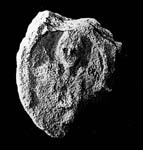
Object type: Part(s) of a cross-head
Measurements: (based on the scaled photographs) H. 28.4 cm (11.2 in); W. 23.7 cm (9.3 in); D. Not recorded
Stone type: Coarse-grained freestone of the Doulting type' (ibid.)
Plate numbers in printed volume: Pls. 252-4
Corpus volume reference: Vol 7 p. 158
(There may be more views or larger images available for this item. Click on the thumbnail image to view.)
'Two fragments of a cross ... From the shape of the fragments they would appear to be parts of the head of a cemetery cross, having four equal arms, terminating in circular segments, and separated by circular hollows. The larger fragment bears on its face a circular sunk panel containing a symbolic figure, having the appearance of a winged skeleton. The eyes of the figure are deeply hollowed, as for a skull. On the reverse is the rope-plait, and the sides have another rope ornament' (Bond 1913, 61, 63).
From the small drawing which Bond published, this seems to have been an important crosshead with interlace on one face of the head and a winged figure on the other. On the basis of the drawing in Bond 1913 and a photograph in the possession of the Abbey Museum (Ill. 253), I have considered that the image in the cross-arm could have been an angel with the gaunt features and hollowed eyes which distinguish so many human or angelic depictions in Mercian sculpture (Cramp 2001, 155). For example, on a stone from Hanley Castle in Worcestershire there is on one face a figure with pointed face and deeply hollowed eyes, which might have held settings of glass or paste (Brown 1937, pl. LXXXVIII, 1), and on the cross at Eyam in Derbyshire similar angels fill each cross-arm (see Ill. 542). This piece therefore could reflect the influence of Mercian styles in the period when Glastonbury was directly involved with the Mercian kings (see introduction p. 6).
