Select a site alphabetically from the choices shown in the box below. Alternatively, browse sculptural examples using the Forward/Back buttons.
Chapters for this volume, along with copies of original in-text images, are available here.


Object type: Fragment
Measurements: H. 14 cm (5.5 in); W. 17 cm (6.75 in); D. 11 cm (4.5 in)
Stone type: As Glastonbury 2
Plate numbers in printed volume: Pls. 236-9
Corpus volume reference: Vol 7 p. 155
(There may be more views or larger images available for this item. Click on the thumbnail image to view.)
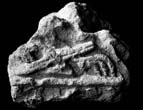
A (broad): Only one face has traces of carving. At the base, much damaged rectangular billets and a plain rounded moulding which encloses the main field. Two strands of median-incised interlace cross in a pointed loop, and one strand passes over a spindly leg which terminates in three long pointed claws and what may be a spur. There are traces of the body to which the leg was attached, but it is not possible to say whether this was a bird or a beast.
B and D (narrow): Broken away
C (broad): Smooth and flat and slightly concave, with a small drilled hole which could be original.
F (bottom): Flat and tooled, could be original.
This could have been part of a decorative wall-slab or frieze, but it is too fragmentary to be certain. It is closely similar in form and ornament to the now lost fragment Glastonbury 10 (Ill. 247), and in style of cutting it is similar to Glastonbury 2 (Ill. 228). Although Radford has dated Glastonbury 10 as tenth century (1981, pl. XXIVc) there seems no reason why it should not be earlier, and part of the group of sculptures which have affinity with the animal and bird motifs of Mercian sculptures (see introduction p. 46).
