Select a site alphabetically from the choices shown in the box below. Alternatively, browse sculptural examples using the Forward/Back buttons.
Chapters for this volume, along with copies of original in-text images, are available here.


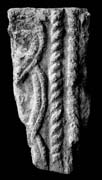
Object type: Fragment
Measurements: H. 22 cm (8.5 in); W. 12 cm (4.75 in); D. 13 cm (5 in)
Stone type: As Glastonbury 2
Plate numbers in printed volume: Pls. 234-5
Corpus volume reference: Vol 7 p. 155
(There may be more views or larger images available for this item. Click on the thumbnail image to view.)
A (broad): Only one carved face survives. On the left two median-incised strands cross over and under, one of them swelling into an animal head with a pointed ear and almond-shaped eye. To the right two separated bands of opposed cable, and beyond that the piece is broken. Traces of burning on the stone.
B (narrow): Broken and mortar covered
C (broad): Broken with mortar
D (narrow) and F (bottom): Broken
E (top): Dressed flat
Interlace terminating in an animal head is also found in sculpture on a Bradford-on-Avon crossarm (no. 2, Ill. 400) and on Dolton 1b, face B (Ill. 21). For the head-type compare the paired animals on the Ramsbury grave-cover (no. 4, Ill. 504) (Cramp 2001, 158–9, figs. 2a and 2b). In manuscripts the type of 'swollen' animal head with almond-shaped eyes is found in the Durham, Cassiodorus MS B.II.30, fol. 81v (Alexander 1978, no. 17, ill. 74), and this feature, like several others at Glastonbury, may have been inspired by manuscript examples. Since the face is incomplete on both sides, both of the strands could have terminated in opposing animal heads, with, like the Ramsbury cover, tongues developing into interlace.
