Select a site alphabetically from the choices shown in the box below. Alternatively, browse sculptural examples using the Forward/Back buttons.
Chapters for this volume, along with copies of original in-text images, are available here.


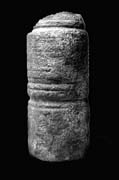
Object type: Baluster shaft
Measurements: H. 37 cm (14.5 in); Diam. 15.5 cm (6 in)
Stone type: Ham Hill Stone (ibid.)
Plate numbers in printed volume: Pls. 352-3
Corpus volume reference: Vol 7 p. 179-80
(There may be more views or larger images available for this item. Click on the thumbnail image to view.)
This appears to be the end and central portion of a cylindrical shaft. At the least damaged end there is a rectangular hole which could have been for the setting on a lathe, but also could have been used to fix the shaft in position. In the most complete section fine single rounded mouldings enclose a bold double rounded moulding. The decoration has been competently turned.
It has been conjectured by Brian and Moira Gittos that this piece, together with part of a plain monolithic window-head found at Church House (Gittos 2004b), could have been part of the early church at Yeovil. This is possible, and Yeovil was a minster church, so one might expect a building of some pretension. Cylindrical balusters without taper and with narrow grooving are not typical of the balusters which are in situ in late Saxon churches in Wessex (Tweddle et al. 1995, 34), and it is quite distinct from the 'moulded' balusters from St Augustine's Abbey, Canterbury (ibid., 132–3, nos. 6 and 7, ills. 41–9), or the collection from Bury St Edmunds, Suffolk (Gem and Keen 1981, 3–19), which has been dated tenth/eleventh century. There seems no doubt that this column is lathe-turned and not formed with a chisel, although Gem and Keen have discussed the problem of distinguishing dowel holes for fixing from those for lathe turning, and have concluded that the holes in the Bury St Edmunds balusters were for fixing because of their smooth rounded shape and length, penetrating as they do as much as 14 cm into the stone. The depth of the hole at Yeovil was at least 2.5 cm.
In the south, most of the baluster fragments from Winchester, Old Minster have been dated by the Biddles as tenth-century, although one fragment of a lathe-turned shaft, no. 16, has been assigned a possible late seventhcentury date (in Tweddle et al. 1995, 284, ill. 514). The Yeovil shaft finds a closer parallel for its form in the ex situ baluster fragment from St Augustine's, Canterbury (ibid., no. 8, ill. 50) which Tweddle has dated to the seventh century on analogy with the lathe-turned balusters from Wearmouth and Jarrow (ibid., 133). The collection of balusters from these two sites also provides the closest parallels for the Yeovil shaft. In scale this baluster is comparable with the Wearmouth rather than the Jarrow group (Cramp 1984, 120–1, 128–9), although because of the nature of the stone the profile is closer in type to the sandstone shafts at Jarrow (ibid., ills. 551–75) than the limestone shafts with fine massed grooves and sharp angles from Wearmouth (ibid., ills. 627–62). Although the origin of such shafts seems to be in the Roman world, this piece is not obviously Roman in form and fits comfortably into the seventh/eighth century group cited above. These derive from Gaulish building traditions (Cramp 1984, 24–5), and it is possible that West Saxon builders were independently influenced by the Franks, as Tweddle has suggested for the Canterbury fragment (Tweddle et al. 1995, 34), but in the context of the Anglo-Saxon church in Somerset a date in the early eighth century rather than the late seventh seems more acceptable.
