Select a site alphabetically from the choices shown in the box below. Alternatively, browse sculptural examples using the Forward/Back buttons.
Chapters for this volume, along with copies of original in-text images, are available here.


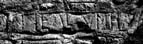
Object type: Slab with inscription
Measurements: H. 10.5 > 9.5 cm (4.25 > 3.75 in); W. 63 cm (24.75 in); D. Built in
Stone type: Heavily lichen-encrusted, yellowish grey (5Y7/2), medium-grained, clast-supported bioclastic limestone. Most clasts are between 0.2 and 0.3 mm, with a few up to 0.5 mm, and vary from sub-rounded to rounded, with the well-rounded clasts resembling ooliths. Doulting stone, Upper Inferior Oolite Formation, Inferior Oolite Group, Middle Jurassic
Plate numbers in printed volume: Pls. 147-8
Corpus volume reference: Vol 7 p. 126
(There may be more views or larger images available for this item. Click on the thumbnail image to view.)
Inscription A fragment of an inscribed stone is visible in the coursed rubble masonry on the external face of the south wall of the nave. The exposed face of the stone displays traces of incised letters, the tops of which have been cut away. The original height of the letters was probably around 9 cm. The lettering must originally have been quite bold but is now damaged and weathered. The remaining letters can be transcribed as follows:
— [N . EA . . VMHA] —
The inscription is incomplete at either end. Further lettering may be lost from above and below what remains. No obvious reading suggests itself but the sequence VMHA may represent the end of a Latin word in –um followed by another starting with ha–.
Inscription The letters are capitals and seem to have been reasonably neat but not strictly regular in execution. The first letter was clearly N and it seems to have followed the 'Roman' form in the way that the diagonal meets the right-hand vertical at the end of the stroke rather than, as often, in early medieval inscriptions, short of it. A blank area followed by a vertical stroke represents one, or perhaps two letters. This is followed by a capital E, the two remaining horizontals of which slope upwards rather than forming a right angle. The A has an angular cross-bar. A back-leaning vertical followed by another now blank area may represent two, or perhaps one, letters. Capital V and M are clear. The outer strokes of the M are more or less vertical, although they lean inwards slightly towards the top, and the angle of the central 'V' reaches no further than about half way down the letter. This is a widespread early medieval variation on the classical form. The most probable reading of the next character is capital H and this is followed by the outer strokes and possible traces of a broken cross-bar of an A. None of the letter forms is particularly diagnostic but the 'Roman' forms and variants of them and the orderly layout would not be out of place in a later Anglo-Saxon inscription of the tenth or eleventh century.
