Select a site alphabetically from the choices shown in the box below. Alternatively, browse sculptural examples using the Forward/Back buttons.
Chapters for this volume, along with copies of original in-text images, are available here.


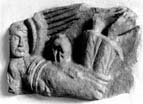
Object type: Figure panel
Measurements: H. 38 > 30 cm (15 > 13 in); W. 66 > 61 cm (26 > 24 in); D. 6 cm (2.25 in)
Stone type: Yellowish grey (5Y 7/2), shelly, poorly sorted, clast-supported limestone, with mostly sub- to wellrounded bioclastic fragments in the range 0.2 to 1 mm across, but mostly between 0.4 and 0.6 mm. Shell fragments (bivalves) maximum of 6 mm across; one bryozoan fragment noted. No obvious alignment of clasts. ?Doulting stone, Upper Inferior Oolite Formation, Inferior Oolite Group, Middle Jurassic
Plate numbers in printed volume: Pls. 149-52
Corpus volume reference: Vol 7 p. 125-6
(There may be more views or larger images available for this item. Click on the thumbnail image to view.)
Only one face is visible. The figure is carved on a single block of stone and in such high relief that it is almost three-dimensional, and depicts an angel in flight with upturned legs and head turned back. It is haloed and winged. The face is rounded with prominent features, but the details are delicately drawn. The mouth is pursed and the chin prominent, and the jaw is sharply drawn; and the prominent, almond-shaped eyes are heavily lidded. Altogether the impression is firmly male. His hair is bound with a double fillet with a central squarish feature which could be a jewel. What appears to be a lock of long hair is curled back behind the ear. His halo is pillowed in his wing which is deeply carved (6.5 cm deep). The drapery is tightly attached to his body, folded like a scarf around the waist with one flying fold; the shape of the legs show through the folds of the drapery as deep incisions, and the bottom of the drapery is shown as nested V-shaped folds. There is a cruder deep fold of drapery under the wing. His right foot which is shown in profile is delicately carved, but his left foot is curiously turned to show an almost frontal position.
This angel has been often compared with the Bradford-on-Avon pair (p. 203, Ills. 404–6) and indeed the form and folds of the drapery (although coarser in detail) are very similar, but there are distinctions which could indicate that this was part of a different composition from the Crucifixion scene which is assumed for the Bradford pair. The arms of this angel are lacking, but there is the hint of a flying fold which could be a napkin covering the hands as at Bradford. It is however the backward-turned head which makes a distinction. In Crucifixion scenes angels attentively look towards Christ or the Cross, but in scenes where the angels support Christ or the Virgin in a mandorla, they sometimes turn to include the spectator in the event (Temple 1976, ills. 31, 253 or 265). In the wall painting at Nether Wallop, Hampshire, which has been dated to the late tenth/early eleventh century (Gem and Tudor-Craig 1981, 127–8, 133–4), two angels support a mandorla, and the head of the northern angel is very similar to Winterbourne Steepleton. The authors note Winterbourne as a work of similar date to the wall painting and consider 'its equally horizontal position suggests a role similar to that of the Bradford-on-Avon pair' (ibid., 130). The stone on which the Winterbourne angel was carved has however been trimmed on all sides, and it could originally have been part of a composition in which the figure was at an angle and looking down at the spectator as it supported a Majestas or an Ascension.
It is an impressive piece and its general affinity with the angels at Bradford or those in late tenth-century or early eleventh-century manuscripts is not in doubt. Whether one should see the simpler and more static drapery as later than the fluttering folds of Bradford or the New Minster Charter (Temple 1976, ill. 84) and more like BL Cotton Claudius B. IV (ibid., ill. 265), which is dated to the first half of the eleventh century, is difficult to decide if one also takes into account the differing skills of the carvers. Previous dating has varied from Talbot Rice's first half of the tenth century (1952, 94) to the Royal Commission's eleventh century (1970b, 395), and although I would incline to a late tenth or early eleventh century date, it is difficult to be precise (see introduction p. 69 for section on dating).
