Select a site alphabetically from the choices shown in the box below. Alternatively, browse sculptural examples using the Forward/Back buttons.
Chapters for this volume, along with copies of original in-text images, are available here.


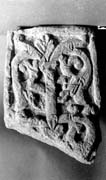
Object type: Part of a grave-cover
Measurements: H. 46.5 cm (18 in); W. 30.5 < 32.5 cm (12 < 12.75 in); D. c. 10 cm (4 in)
Stone type: Yellowish grey (5Y 7/2), medium-grained (range 0.3 to 0.5 mm, mostly 0.4 mm diameter), matrixsupported oolite. A few scattered shell fragments up to 4 mm across. Ooliths weather out to give 'aero-chocolate' texture. Bath stone, Chalfield Oolite Formation, Great Oolite Group, Middle Jurassic
Plate numbers in printed volume: Pls. 324, 327
Corpus volume reference: Vol 7 p. 176
(There may be more views or larger images available for this item. Click on the thumbnail image to view.)
Only one face is carved, and at the narrower end of the piece the decoration is surrounded by plain chamfered frame. Filling the frame is a symmetrical plantscroll in bold relief against a recessed background on which traces of dark red paint have been observed (Rodwell 1990, 161–2, pl. 1). This tree-scroll consists of a straight central stem terminating at the narrow end in a rounded cup, from which spring a plume of three rounded and scooped leaves, and on either side two thick plant-strands with long curling leaves at the top which are divided from the side shoots below by double nicks. Similar pairs of nicks divide the plant elements on the shoots. These consist of a leaf-flower curled in to touch the central stem, its outer leaves enclosing a central bud, deeply indented, which sprouts from a V of two scooped inner leaves. From this springs another tendril terminating in a rounded and curling leaf which fills the space above. A second pair of side shoots partially survives, the junction with the main stem being overlaid by three rounded and scooped leaves. The most complete lateral shoot is marked by a pair of nicks where a small rounded leaf curls back to the stem and then curls and divides, so that one tendril with a long triangular leaf with a curling tip passes underneath it. The main plant elements are quite sharply chamfered, which together with the nicks gives the impression of a metalwork motif.
Although this form of tree-scroll shares some features with other plant-scrolls on manuscripts, as West has indicated, unlike the grave-slabs from St Oswald's Priory, Gloucester (West 1984b, 43, ill. 24), Bath 7 (Ills. 183–5) or Braunton 1 (Ill. 1), this piece has no acanthine features (West 2001, 489). The stiff central stem and the chamfered or faceted edges of the plant elements, together with the nicks, give the impression of metalworking training or inspiration rather than stonecarving, but of something coarser than the back of the Alfred Jewel (Backhouse et al. 1984, ill. 13) with which West compared it. The disposition of the ornament, and the thick central stem with nicks, as well as the flower forms, are most closely paralleled in sculpture by the panel on the north face of the Anglo-Saxon tower at Barnack, Northamptonshire (Cramp 1975, fig. 20). But nevertheless the thick columnar central stem, the trefoil of indented and rounded leaves which sprout from a rounded cup on the stem, and even the form of the leafflowers is very like the Gloucester piece (Fig. 22o). West's alternative explanations for the simplicity of the Wells 1 grave-cover are: a) that it may be 'an earlier or transitional example of the tree "scroll" motif ', or b) that it is 'a derivative piece which reflects, in a simplified form, the sophisticated repertoires of more progressive artists active in the second quarter of the tenth century' (2001, 489). This last seems to me the more convincing explanation, since the stem and plant forms are like cruder examples of Braunton and Gloucester, and not like the segmented triangular stem and scimitar-like leaves of the back of the Alfred Jewel (Fig. 22d; see also introduction p. 54).
