Select a site alphabetically from the choices shown in the box below. Alternatively, browse sculptural examples using the Forward/Back buttons.
Chapters for this volume, along with copies of original in-text images, are available here.


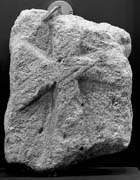
Object type: Grave-marker / head or footstone
Measurements: H. max. 33.5 cm (13.25 in); W. 24 cm (9.5 in); D. 10 cm (4 in)
Stone type: All four pieces (nos. 2–5) are similar and consist of medium-grained, glauconitic sandstone. Grains poorly sorted, sub-angular with discrete grains of glauconite. Has a rough, gritty texture. The pentagonalsided fragment has Exogyra shells on the surface. Shaftesbury Sandstone Member, Upper Greensand Formation, Lower Cretaceous
Plate numbers in printed volume: Pl. 92
Corpus volume reference: Vol 7 p. 109
(There may be more views or larger images available for this item. Click on the thumbnail image to view.)
The stone is a narrow rectangle tapering slightly. Only one face is carved, with a cross in high relief. The verticals are slightly splayed (type B1) whilst the side arms are wedge-shaped (type B6). The background is tooled.
Small simple grave-markers such as this were probably derived from the monastic cemetery. The very unweathered nature of the stone could be because it had been buried at an early stage. The variation of arm type is also found in slabs from Stedham, Sussex (Tweddle et al. 1995, ills. 239–48).
