Select a site alphabetically from the choices shown in the box below. Alternatively, browse sculptural examples using the Forward/Back buttons.
Chapters for this volume, along with copies of original in-text images, are available here.


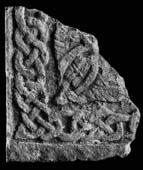
Object type: Slab / cross(?)
Measurements: H. 27.5 cm (10.75 in); W. 24.7 cm (9.75 in); D. 11.5 cm (4.5 in)
Stone type: Oolitic shelly, matrix-supported limestone with ooliths. Ooliths poorly sorted, mostly standing proud, but some areas of 'aero-chocolate' texture. A few small dark clasts; shell fragments up to 1 cm across. Bath stone, Chalfield Oolite Formation, Great Oolite Group, Middle Jurassic
Plate numbers in printed volume: Pls. 89-91
Corpus volume reference: Vol 7 p. 109
(There may be more views or larger images available for this item. Click on the thumbnail image to view.)
A (broad): Panel with a broad flat border enclosing a frame of four-strand interlace, half pattern F. This inner border frames a serpentine animal in which part of its body is fettered with a wide knotted strand. The body of the animal is roughly incised with herringbone hatching and a median strand.
B (narrow): Broken
C (broad): Dressed back
D (narrow): Only part of this face survives. Within a double flat-band border is part of the head of a serpentine animal, seen from above; the eyes are deeply punched and outlined by a long curling scroll.
E (top): Broken
F (bottom): Dressed with diagonal tooling, probably original
It is not entirely clear which way up this piece was, nor what its form was originally. The carving on two faces would indicate that it was free-standing but the interlace framing of the panel is not normal on crossshafts. It could have been a base. The ornament is generally accepted as placing it within the group of West Saxon ribbon animals first defined by Cottrill (see introduction p. 42). Amongst this group it is most like Tenbury Wells, Worcestershire (Ills. 546–7), which has on one face a lacertine beast with herringbone hatching and on the other a serpentine creature with head seen from above. Shaftesbury was an important monastic site, a royal foundation for nuns (see introduction p. 9), but this piece is not of the highest quality of carving.
