Select a site alphabetically from the choices shown in the box below. Alternatively, browse sculptural examples using the Forward/Back buttons.
Chapters for this volume, along with copies of original in-text images, are available here.


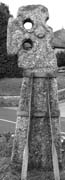
Object type: Wheel-headed cross
Measurements: H. 142 cm (56 in); W. (head) 35 cm (13.75 in); (shaft) 24 < 41 cm (9.5 < 16 in); D. 17 < 19 cm (10.5 < 11.5 in)
Stone type: Pinkish grey (5YR 8/1), coarse, sparsely micaceous, tourmalinised granite with K-feldspar megacrysts up to 3 cm across. The elongate tourmaline crystals mostly occur as discrete crystals 1 to 3 mm across, but they are also clustered in patches up to 1.5 by 5 cm. Typical of Dartmoor Granite on the south side of the batholith. [1]
Plate numbers in printed volume: Pls. 34-8
Corpus volume reference: Vol 7 p. 87-9
(There may be more views or larger images available for this item. Click on the thumbnail image to view.)
The head and the shaft are carved from a single block of stone. There are no edge mouldings on the shaft, which is plain save for the inscription near the base on one broad face. This is set within incised horizontal framing lines. The shaft is slab-like and tapers sharply towards the head. The wedge-shaped arms (type B12) of the head are outlined in heavy roll mouldings and there are prominent bosses in the centre. The ring is type 1a.
Inscription An inscription (Okasha 1971, 106; Okasha 1993, 208–10, fig. II.41) has been cut onto one of the two broad faces near the bottom of the shaft. It consists of four letters and runs horizontally between two incised framing lines that are set about 27 cm apart. The lower framing line is only about 9 cm from the bottom of the cross-shaft. This would scarcely be sufficient to fix the cross securely into the ground or a base and so it is probable that the shaft was originally somewhat longer. The framing lines suggest that the inscription is complete as it stands. The first letter is about 11 cm high and the last letter about 15 cm. The letters were originally large and bold but are now worn. According to Okasha (1993, 209), the inscription has deteriorated since she first examined it in 1964. She was then confident that it read: ELEš. That is compatible with what can now be seen on the stone, although there is now no clear evidence of a central horizontal in the first letter, which could therefore on the basis of its present condition have been either a rectangular C or a capital E. Wynn is the most probable reading of the final letter. The text can therefore be transcribed either as:
[CL]EǷ
or
[EL]EǷ
Such a short and indistinct sequence is extremely difficult to interpret. Okasha's ingenious suggestion that ELEW could stand for an Old English personal name Elewynn is formally possible, though in such a context it can hardly be confirmed. Ele would stand for Æ gel, commonly found in the eleventh century for classical OE Æðel (Colman 1981; Smart 1983). The single rune 'w' could be used to represent the rune-name, and name-element, wynn; for examples of this practice on coins see instances of W[yn]beorht and W[yn]sige in Smart 1981, 83. It is interesting, and in the present context perhaps unhelpful, that both phenomena ('w' for the name-element wynn and
The forms of the capitals call for some comment. As has been seen, the first letter was either Roman capital E or rectangular C. In either case, it was a narrow version of the letter and the angles are somewhat rounded, particularly at the top. The next letter was almost certainly L. There are, however, two possible horizontals. The lower 'horizontal' is a curving stroke, apparently continuous with the vertical. A little above this is a straight horizontal stroke meeting the vertical at a definite right angle. One of these two 'horizontals' was presumably a correction, modification or restoration of the other, if it is not accidental. The curving form would have corresponded with the Insular half-uncial letter, the angular form with the Roman capital. (What in photographs looks like a second vertical a little to the right of the vertical stroke is in fact a stain in the stone and not an incised stroke.)
The third letter is clearly an E but its three 'horizontals' tilt jauntily upwards towards the right, and its vertical extends some way above and below the junction with the upper and lower horizontals. This form of E (and comparable forms of other capitals with extended verticals) can be paralleled amongst sixth- to eighth century inscriptions in Gaul, in a handful of Insular inscriptions and in the display script of a few Insular manuscripts (Le Blant 1896, 195–7 and passim; Higgitt 1982, 315). The Insular examples are early and datable to between the seventh and ninth centuries. They include inscriptions from Lethnott and Whithorn in Scotland and Maughold on the Isle of Man and three manuscripts of around the first half of the eighth century (Okasha 1985, 47, 53–4, pl. III.3; Curle 1940, pl. XVIIIa; R.C.A.H.M.S. 1912, 165, fig. 109; Kermode 1907, 74–5, 111–12, fig. 43, pl. LXVI; Cubbon 1983, 7; Alexander 1978, ills. 49, 60 and 68). The final letter was almost certainly intended as wynn and, if so, it was a less controlled version of the form of wynn to be seen, for example, in the fragment of an eleventh-century sundial at Skelton in Cleveland (Lang 2001, 195–7, ill. 744). Alternative readings such as capital P or D would require the letter to be strangely misshapen.
Inscription This short inscription presents a puzzling set of letter forms. As has been seen, parallels for the capital E with its extended vertical point to a period no later than the ninth century. Rounded forms of L deriving from the half-uncial letter, if that was the intended form, would not be expected later than the ninth century in Anglo-Saxon inscriptions (cf. Okasha 1964–8, table 1b). On the other hand, in an English context, the use of wynn, if that is what it is, would suggest a date around the tenth or eleventh centuries (for epigraphic examples see Okasha 1964–8, table 1a). Okasha's tables of letter-forms in early medieval inscriptions in south-west Britain (all, with one exception, in Cornwall and Devon) show no examples of E with extended vertical and perhaps three of curved L (Okasha 1993, tables 1a–3b). Her one example of wynn, at Lanteglos in Cornwall, is an inscription with an Old English text, which she would date no earlier than the eleventh century (Okasha 1971, 90–1, pl. 69a–b; Okasha 1993, 141–5, figs. II.22(i–ii), table 1a).
The text was presumably a personal name and it is possible but far from certain that it was Old English in its forms. The inscription may well have been secondary and its purpose was probably, but not certainly, to commemorate the person named.
The horizontal setting of this text on the shaft of the cross conforms to what was the most common arrangement of inscriptions on crosses in early medieval Britain and Ireland (Higgitt 1986b, 127, 129–30, 137). This is equally true of the inscribed crosses of Devon and Cornwall (Okasha 1993, 12, 29). Okasha (1993, 29) counts Plymstock as one of six out of the eleven inscribed cross-shafts in this region to display an inscription on the lower part of the shaft in a way perhaps suggested by Irish practice. This may true but, as has been seen, the original length of the shaft at Plymstock is uncertain since the bottom seems to have broken away.
Shafts such as this which are plain with no edge mouldings are usually a late type, tenth to twelfth century in other parts of the country. A rounded head, which has no lower vertical arm but grows naturally into the shaft, is a feature of many Cornish crosses, but more frequent on the small monuments. In the discussion of the inscription Higgitt quotes several Cornish parallels, and this cross stands outside the main distribution of Anglo-Saxon monuments (see introduction, p. 34). As with the other granite crosses of Devon this monument seems to look west for its inspiration, and since this cross is made of Cornish granite it is possible that it was imported whole to the site, perhaps by sea.
[1] The identification of stone type here is by R. C. Scrivener.
[2] This paragraph is by David Parsons.
