Select a site alphabetically from the choices shown in the box below. Alternatively, browse sculptural examples using the Forward/Back buttons.
Chapters for this volume, along with copies of original in-text images, are available here.


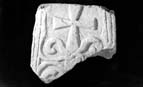
Object type: Slab / grave-cover
Measurements: H. 32 cm (12.5 in); W. 31 < 33 cm (12.25 < 13 in); D. 11.5 cm (4.5 in)
Stone type: Pale grey (N7), very fine-grained, micritic limestone with no obvious internal structure. There are a few scattered shell fragments up to 2.5 mm across, with one well-preserved pectenid measuring 12 mm. The stone is fairly soft and easily marked. ?Blue Lias Formation, Lias Group, Lower Jurassic
Plate numbers in printed volume: Pls. 370-1
Corpus volume reference: Vol 7 p. 185
(There may be more views or larger images available for this item. Click on the thumbnail image to view.)
Only one face is carved. The slab is edged by two incised lines to make a double moulding, and at the narrower end a cross with splayed arms, type 6b, is neatly cut with a chisel, and from the tip of one vertical arm spring a pair of coils separated by a wedge-shaped feature in relief. The surface of the background is notably smooth. The sides are roughly pecked back and the back is finished with rough hatching.
Appendix A item (stones dating from Saxo-Norman overlap period or of uncertain date).
This has been considered as an Anglo-Saxon piece (pers. comm. English Heritage, Salisbury). Although at first sight this appears to be a cross emerging from plant coils, if one considers the wider end as the top then one can reconstruct a slab decorated with a cross with sunken centres, the spandrels of the arms filled with oils, and a small cross on the vertical stem. In this case a post-Conquest date is clearly to be preferred. B. and M. Gittos have compared the cross shape here with a simple cross on a long stem on slab no. 6 from Wells, that by context is dated to before c. 1190 (2001, 495, fig. 494), which is consonant with the date proposed for this piece.
