Select a site alphabetically from the choices shown in the box below. Alternatively, browse sculptural examples using the Forward/Back buttons.
Chapters for this volume, along with copies of original in-text images, are available here.


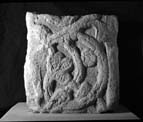
Object type: Fragment of rectangular shaft
Measurements: H. 33 cm (13 in); W. 30.5 > 29 cm (12 > 11.5 in); D. max. 13.5 cm (5.25 in)
Stone type: Grey-painted, pale yellow-brown (10 YR 8/3–4) oolitic limestone, composed of 0.4-mm ooliths in a calcite matrix; a few calcite veinlets. Bath stone, Chalfield Oolite Formation, Great Oolite Group, Middle Jurassic
Plate numbers in printed volume: Pl. 468-9
Corpus volume reference: Vol 7 p. 223
(There may be more views or larger images available for this item. Click on the thumbnail image to view.)
A (broad): The face is edged by a broad flat-band moulding. Part of a plant-scroll with incised stem and long triangular leaves with double outlines and cross-ribbed centre; the stems penetrate the leaves. Sprouting from the stem is a berry bunch, and another strand terminates in a trefoil clubbed leaf or buds, also with cross-ribbed centre. (Width of main crossing strands c. 3.2 cm / 1.25 in.)
B (narrow): The moulding only survives on one side, and encloses damaged and incomplete interlace in which two median-incised strands cross, but the whole pattern is not recoverable.
C and D: The other faces broken away
This is the most substantial of the surviving fragments here and is without doubt part of a shaft. The distinctive trefoils with double outlines and cross-ribbed centre, are, like the leaves and berry bunch, a coarser and more metallic form of similar scrolls elsewhere, such as Acton Beauchamp, Herefordshire (Cramp 1977, fig. 61d) and Colyton, Devon (Ill. 4). Here, the sort of surface decoration which is applied to the lacertine animals (see introduction pp. 42–6) is used on plant forms. Such a tendency was already evident in the outlined leaves and berry bunches at Britford (Ills. 411–20) and the hatched plant elements at East Stour (Ills. 57–64), but the trefoil bunches and the hatching of the stems as well as the other plant elements seem, like the hatched animal bodies, to be a western Mercian fashion which is then adopted in Wessex (cf. Kendrick 1938, pl. LXXX). There is no doubt that the plant form is based on a berried scroll and not on the later acanthus, and this type of scroll with a likeness to Cambridge, Corpus Christi College MS 183, fol. 1v (Ills. 529–34; Temple 1976, no. 6, ill. 29), could indicate a date in the ninth century, in sculpture and other media.
