Select a site alphabetically from the choices shown in the box below. Alternatively, browse sculptural examples using the Forward/Back buttons.
Chapters for this volume, along with copies of original in-text images, are available here.


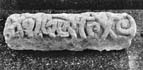
Object type: Part of rounded shaft
Measurements: H. 54 cm (21.25 in); W. 16 > 15 cm (6.5 > 6 in); D. 13 cm (5 in)
Stone type: Yellowish grey (5Y 8/1), dominantly medium-grained, shelly, matrix-supported oolite, with the ooliths weathering out to give an 'aero-chocolate' texture; a few stand proud. Shell fragments up to 5 mm across, but no obvious alignment. Bath stone, Chalfield Oolite Formation, Great Oolite Group, Middle Jurassic
Plate numbers in printed volume: Pl. 84
Corpus volume reference: Vol 7 p. 107-8
(There may be more views or larger images available for this item. Click on the thumbnail image to view.)
Part of a rounded shaft with loose medianincised interlace.
This was originally a rounded shaft like Yetminster (Ills. 153–7). The interlace type does not conform to any geometric type, but this is common in this region: the particularly tangled form here may be compared with Whitcombe (Ill. 142).
This is an important site with a large land-holding (Hall 2000, fig. 74). Milton Abbey was traditionally founded by King Athelstan (925–40), and was certainly a religious site by 964: see Anglo-Saxon Chronicle MS A, that tells of substitution of monks for priests (Whitelock 1979, 226).
