Select a site alphabetically from the choices shown in the box below. Alternatively, browse sculptural examples using the Forward/Back buttons.
Chapters for this volume, along with copies of original in-text images, are available here.


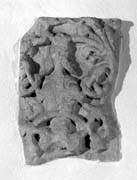
Object type: Fragment
Measurements: H. 48 cm (19 in); W. 34 cm (13.5 in); D. 2 cm (0.75 in) visible
Stone type: Very pale grey (N8), poorly sorted, dominantly medium-grained oolite (with a few coarsegrainedooliths). Ooliths matrix-supported and most weather out to give an 'aero-chocolate' texture; a few stand proud. Prominent water mark across the middle of stone (horizontal to stone as mounted). Scattered shell fragments up to 5 mm across pick out the bedding (vertical to stone as mounted). Bath stone, Chalfield Oolite Formation, Great Oolite Group, Middle Jurassic
Plate numbers in printed volume: Pls. 82-3
Corpus volume reference: Vol 7 p. 106-7
(There may be more views or larger images available for this item. Click on the thumbnail image to view.)
In the centre is an animal seen from above, its limbs outstretched and enmeshed in a plant-scroll. The animal has a rabbit-like head with long pointed ears, and appears to be gnawing the plant. In its body are several half-moon nicks. The body tapers towards the back legs. The plant form is difficult to characterise — a frond at the top appears to have pointed curving leaves, with a triangular flower or leaf in the centre.
Animals seen from above are common in Anglo-Saxon sculpture, but are usually bipeds (Cramp 1977, fig. 62c, e, f). Its sprawling stance is like the winged creature on a Breedon, Leicestershire, cross-shaft (ibid., fig. 62g), and indeed on a ninth-century cross also at Breedon there is a leaping canine enmeshed in plantscroll whose body is similarly decorated with half-moon nicks. This type of surface decoration is probably derived from metalwork, and in fact the closest parallel for the Melbury Osmond beast is on the right-hand pin head from the Witham suite (Wilson 1964, pl. XVIII).
This piece therefore has strong Midland characteristics. It is unfortunate that the plant forms are so worn, but the spray of leaves and flowers at the top right differs from the formal vinescroll or acanthus, and this too finds some parallel in metalwork such as the Beeston Tor disc brooch (Webster and Backhouse 1991, ill. 245b), and in the Cranborne panel (p. 100, Ill. 56) where the beast also has some Midland affinities.
