Select a site alphabetically from the choices shown in the box below. Alternatively, browse sculptural examples using the Forward/Back buttons.
Chapters for this volume, along with copies of original in-text images, are available here.


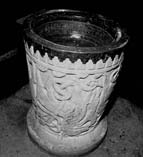
Object type: Part of a columnar cross or font
Measurements: H. 71 cm (28 in); Diameter: 57 cm (at top) > 48 cm (22.5 > 19 in); Circumference: 180 cm (at top) > 157cm (71 > 62 in)
Stone type: The font is heavily patinated and with some lichen encrustation. One small area shows a dominantly medium-grained, clast-supported, yellowish grey (5Y 7/2) oolite with ooliths standing proud. Ooliths in the range 0.3 to 0.5 mm diameter; a few platy shell fragments up to 3 mm across. ?Portland stone, Portland Freestone Member, Portland Limestone Formation, Portland Group, Upper Jurassic
Plate numbers in printed volume: Pls. 71-81
Corpus volume reference: Vol 7 p. 104-6
(There may be more views or larger images available for this item. Click on the thumbnail image to view.)
Although now used as a font with the animals upside down (Ills. 71–2, 74–7), the piece must originally have been the other way up (see Ills. 73, 78–81), and is described in that way.
At the top is a flared rim surrounded at the neck by tiny billets, and between that division and a flat-band moulding below are four large animals with tails extended into space-filling interlace, and between each large animal there are smaller creatures.
The large animals seem to be grouped in two facing pairs. In one a lion-like beast faces a stag; the lion has a distinct mane and plumed tail, and a canine face, its jaws are half open and it is licking the small quadruped suspended in front of it. The stag has fine branching antlers and seems well observed and naturalistic. Its head is turned back, almost touching a small biped with short flippers and a long tail, whose beaky jaws are clasping a strand of interlace which also passes through the jaws of the stag.
The other facing pair consist of a great cat-like creature with its back to the lion, with a collar-like feature around its neck. Its toothy jaws are open and its tongue hangs over a small quadruped which is held by the neck in the mouth of a facing quadruped, shown en face. This creature has a long curving neck and a horse-like head. All of the large animals except for the stag have clawed feet.
What is now the top, but was once the base, is encircled by grooved rectangles. It is possible that these have been cut into the original surface of the shaft when the lead lining of the font was put in.
The most convincing interpretation of these animals has been made by Yapp (1989) who related them to the allegorical creatures as described in medieval bestiaries. If interpreted in this way, the lion is breathing life into its cub which has been born dead, 'until their father, coming on the third day, breathes in their faces and makes them alive' (Yapp 1989, 128). The creature towards which the stag is turning he identifies as a species of 'serpent', quoting: 'When they (i.e. stags) feel themselves to be weighed down by illness, they suck serpents from their holes ... and ... are restored to health by a meal of them' (ibid.). The cat-like creature with its back to the lion, Yapp identifies as 'a lioness, doing nothing in particular, as she does in most bestiary pictures of leo' (ibid.). The large quadruped which faces it and is turned towards the viewer gripping the neck of the small quadruped, Yapp identifies as a hyena seizing a dog, quoting: 'The hyena ... frequents the sheepfold ... and is able to do imitations of the human voice. ... Such dogs as it has called out like this, it gobbles up' (ibid., 129). He also notes that the other bestiary role of a hyena is to seize corpses from graves. This is in fact the role much more frequently illustrated, and indeed only one manuscript (Cambridge, University Library, MS Kk.4.25, fol. 71v) shows the hyena carrying a dead dog in its mouth, but I would agree with Yapp's identification of all the animals save the lioness, which I identify as a panther, for reasons set out below.
The consideration, however, if one is to date this piece as pre-Conquest, is whether bestiaries and in particular illustrated bestiaries were current in Anglo-Saxon England, as opposed to the twelfth-century bestiaries used by Yapp. The exact date and provenance of the original Physiologus or 'Natural Philosopher' is conjectural, but Alexandria in the second or third century AD is favoured as a likely place for the exploration of creatures of nature for what they revealed of the hidden power and wisdom of God (Squires 1988, 14–15). Latin translations are extant in the west from the eighth century, and the earliest surviving illustrated Physiologus(Bern, Latin MS 318) from the ninth (ibid., 16–17). The text, at least, was known to Aldhelm, abbot of Malmesbury, 'since he drew on it at the end of the seventh century for his collection of Riddles' (Hicks 1993, 108–9, 292–3). It is possible then that the work could have been circulating in the ecclesiastical circles of western England from an early date and perhaps even in an illustrated form.
Within the compendium of Old English poems known as the 'Exeter Book' (because it was given to Exeter Cathedral by Bishop Leofric, bishop of the western see, 1046–72), are three poems on bestiary creatures which plausibly have been extracted from the complete Physiologus to develop the theme of salvation and the love of Christ for man (Squires 1988, 24). The three creatures are the Panther, the Whale and the Partridge. The panther in the Anglo-Saxon poem (ibid., 37–40) is described as beautiful and shining with many colours like Joseph's coat, and is a friend to all creatures except the serpent dragon. When it has eaten it rests in a secret place in a hill cave and then after three days it rises up and a most delightful sound issues from its mouth, and after the voice a sweet smell, a delightful breath comes out, 'stronger and sweeter than any fragrance or the blossoms of plants', and this attracts all creatures and mankind to it. The poet explicitly then compares the panther with Christ, who is the friend of all except the dragon 'who is the ancient fiend'. 'Christ, lord of the angels and giver of victories suffered death for us for three nights', but the sweet scent of his resurrection spread through all the world attracting to himself people from far and near (translations by R.C.). The form of the animal's head on the shaft is subtly differentiated from the lion, and it is shown with its mouth open and something issuing from it which could signify its sweet breath. So rather than just being a spare lioness it could well be a panther. Like the lion it signifies Christ's resurrection and salvation, and both beasts are shown in a pacific role. The stag is consistently the most prominent animal to accompany the panther in bestiary illustrations, and this is explained by Hassig: '... both the panther and the stag are figures of Christ but in two different aspects: the panther signifies his goodness by which he attracts the faithful, whereas the stag represents his power over evil' (Hassig 1995, 161).
The stag is frequently mentioned in scripture, and in early Christian art the stag drinking from water is associated with baptism, in which context it can be noted that around the font at Potterne, Wiltshire, is the quotation from Psalm 42. 1, 'As the hart panteth after the water brooks, so panteth my soul after thee O God' (see POTTERNE (St Mary) p. 225). The stag in the bestiaries is not only a type of Christ and enemy of the serpent (the devil) but also signifies the human soul, and here, despite the oddity of the 'serpent', is most probably meant to be seen as sucking up the creature from its hole, as Yapp suggested. The stag reaches back for the 'serpent', which is placed directly contiguous to the other attacking creature, the hyena.
The hyena, as mentioned above, is usually shown despoiling tombs, and in the majority of the bestiary manuscripts is interpreted as a figure of the Children of Israel, the Jews, reviled because of their rejection and murder of Christ, but redeemed if converted and baptised. As discussed by Hassig (1995, 152–4, fig. 159), one illustration shows a hyena pulling part of a body from a font-like object (London, BL Add. MS 11283, fol. 5), so that this may have been an implicit reference to salvation by baptism. Although the riots in York in 1190 are usually cited as the first instance of anti-Jewish activity in England, ælfric demonstrates that anti-Jewish sentiment was felt long before that: in his Life of St Edmund, he says: 'Christ shows men through his glorious saints that he is Almighty God who can perform such marvels, although the wretched Jews denied him entirely, for which they are accursed as they wished for themselves' (OE text in Needham 1976, 58–9; trans. R.C.). Elsewhere in Anglo-Saxon sculpture the Jewish High Priest is shown attacking the bier of the Virgin on the Wirksworth slab, Derbyshire (Hawkes 1995, 252, fig. 6).
The fact that all of the major creatures are shown in profile, other than the presumed hyena, may indicate a difference between the good and evil creatures, but in later bestiary illustrations the lion, panther and stag are usually shown in profile whilst the hyena is normally shown with face turned to the spectator, since it is reaching to gnaw at the corpses in their graves or tombs (Hassig 1995, figs. 33–45, stag; 148–158, hyena; 162–174, panther). The stance of the creatures may then have been determined by their model. As Hassig wisely says, 'There are cases in which the same pictorial element apparently conveys the same meaning in different contexts, but this is by no means a consistent pattern. For this reason, each image requires internal analysis before it can be compared to other images illustrating the same subject' (ibid., 21). In the interpretation of the shaft that I have suggested there are contrasts as well as similarities in each pairing: the lion revives the little quadruped by licking it, while the stag turns to pull in the little enmeshed biped; the hyena attacks the small creature which it holds in its jaws, whilst the panther breathes over it.
Whilst there is nothing distinctively Anglo-Saxon in the style of these carvings there is nothing distinctively Romanesque either, and since there is clear evidence in the literature for a knowledge of the Physiologus in Anglo-Saxon England from the time of Aldhelm, and texts in the vernacular appear in the Exeter Book, it seems reasonable to place this in pre-Conquest Wessex. Isolated depictions of fabulous and real creatures have survived in late Anglo-Saxon manuscripts such as 'The Marvels of the East' or Herbaria Temple 1976, ills. 185, 188) and in marginal illustrations (ibid., ill. 263), and such drawings could well have been the source of inspiration for these beasts.
Finally one must say something about the form of this piece. Since the shape of the font from which the hyena is pulling a body in BL Add. MS 11283, fol. 5 (see above) is curiously like the Melbury Bubb monument, one might consider whether this is really a round shaft which has been reused. This is the accepted opinion, and there are other, if less substantial, round shafts in this region (see Ills. 84, 153–6, 159). Nevertheless there are no other columns of this scale and type, and it appears complete. The flared rim and bucket-like form could well have been suitable for a late Saxon font, at a period when they were just coming into general use (see introduction p. 38). The current lead lining of the font as it stands has a small hole in the base but this is blocked (Ill. 71), and if it had been hollowed from a column any drain hole would have needed to pierce the column length, but the same could be said if it were the other way up. In that case it could have served as the base to support a basin now lost, rather in the manner of the font at Deerhurst, Gloucestershire, and this seems to be the most plausible interpretation for this stone (see introduction p. 38). Several of the images have been shown to be related to the theme of baptism, and this could support the idea of its original function. But only knowledge of what the interior of the current base was like, and also of when and why it was reversed could resolve the question.
