Select a site alphabetically from the choices shown in the box below. Alternatively, browse sculptural examples using the Forward/Back buttons.
Chapters for this volume, along with copies of original in-text images, are available here.


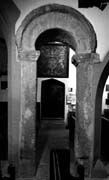
Object type: Architectural
Measurements:
Doorway:
H. 263 cm (103.5 in); W. 74 > 72 cm (29 > 28.5 in); D. 38 > 31 cm (15 > 12 in)
Arch:
H. (above springing line) c. 88 cm (34 in); H. (of voussoirs) 44 cm (17 in); W. (outer) 142 cm (56 in)
West impost
H. 17 > 15 cm (6.5 > 6 in); W. 36 cm (14 in); D. 38 cm (15 in)
East impost:
H. 18 cm (7 in); W. c. 40 cm (16 in); D. 38 cm (15 in)
Stone type: [Not seen]
Plate numbers in printed volume: Pl. 463-7
Corpus volume reference: Vol 7 p. 220-1
(There may be more views or larger images available for this item. Click on the thumbnail image to view.)
On the south face of the doorway, the arch, which is markedly horseshoe in shape, is outlined by a hood-moulding of square section. This terminates on each side in shaped stones which could be animal heads with dotted eyes, pointed laid-back ears and squared-off muzzles.
The chamfered imposts below are each composed of a single block, but divided at the chamfer and base by narrow grooved mouldings.
Taylor and Taylor described the end stones of the hood-moulding as giving the 'impression of being much-weathered animal heads, similar to those at Deerhurst, but smaller and simpler' (1965, I, 390). Baldwin Brown, who considered the arch, apparently did not see these end stones as animal-headed (1925, 466), but more recently Richard Bailey has also compared them with the Deerhurst label stops (Bailey 2005, 5, pls. 1–2).
