Select a site alphabetically from the choices shown in the box below. Alternatively, browse sculptural examples using the Forward/Back buttons.
Chapters for this volume, along with copies of original in-text images, are available here.


Object type: Panel
Measurements: Impossible now but see below
Stone type: Too high to record
Plate numbers in printed volume: Pl. 305
Corpus volume reference: Vol 7 p. 169-70
(There may be more views or larger images available for this item. Click on the thumbnail image to view.)
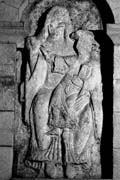
The figures are carved on a round-topped panel, the edge moulding of which partly survives on the left-hand side. Despite the severe damage to the faces this is without doubt a Virgin and Child composition, and the figures seem to be almost life size. Christ is seated across the Virgin's left knee and leaning back in an almost frontal position, one bare foot turned and the other forward. There was a halo around his head, but this was deeply cut and has been largely broken away. The details of his face and hair have been obliterated. A book is prominently displayed in his left hand, and his right arm is extended with the first two fingers held up in blessing. The effect of his arm extended horizontally across the Virgin's body is also to point towards something in the Virgin's hand. She is frontally facing, her left arm around the Child, and her right hand which is broken off is uplifted to hold something which could be rounded like an orb. Her pointed shoes are resting on a block, and there appears to be something like a seat on either side of the figures. Her hair is covered by a long veil but her face is disfigured.
The Child wears a sleeved outer garment bound in at the waist and falling below his knees with a decorated hem, whilst over his arm is a scarf-like feature which is gathered in folds below the Virgin's hand. His undergarment falls in fans of folds around his legs and ankles. The Virgin wears an undergarment with tight sleeves and a sleeved ankle-length overmantle which fans out in undulating folds around her feet. The Child's garments are elaborately decorated with meaningless nested U and V-folds, but the main area of the Virgin's dress is plain.
Although Pevsner says of this piece, 'probably thirteenth century' (1958b, 214), and it is not included by Foster in her pre-Conquest list (1987, 71), no reasons are advanced by either for a post-Conquest date, and a strong case can be made for it to be Anglo-Saxon, and for it to be considered alongside other late Saxon panels such as the Bristol Christ (Ill. 198), the Inglesham Virgin and Child (Ill. 453), or the Virgin at Deerhurst, Gloucestershire (Rice 1952, pl. 18a). A pre-Conquest date has also recently been attributed to this piece by Richard Marks (2004, 40). The sharply cut nested Vfolds of the Child's drapery are a feature also found on the Bristol Christ and several eleventh-century Anglo-Saxon manuscripts such as BL Cotton Claudius B. IV (Temple 1976, no. 86, ills. 265, 266) or BL Arundel 60, fol. 12v (ibid., no. 103, ill. 312). Details of the Virgin's dress were probably painted, as is presumed for the Deerhurst or the Inglesham Virgin (p. 219).
As is noted at Inglesham and in the introduction (see pp. 57-8, 219), devotion to the Virgin increased in late Anglo-Saxon England, and she is the patron of many of the reformed monasteries (Clayton 1994, 131–7). The iconography here is not the same as Inglesham, but can be paralleled in the disposition of the figures in an initial in the 'Grimbald Gospels', BL Add. MS 34890, fol. 15 (Swarzenski 1954, ill. 141), or the Golden Madonna of Essen, who holds up an orb that the Child is reaching towards (Backes and Dolling 1969, fig. on 202) in the manner of the figures here. In fact the two figures facing outwards, with the Child seated across the Virgin's knee, seems to be the norm in late Anglo-Saxon art. This is the posture in an ivory panel now at Oxford (Backhouse et al. 1984, 120, ill. 122), and on the Nunburnholme cross in Yorkshire (Lang 1991, ill. 711); see also Clayton 1990, 176-7. It would seem that the Virgin is sometimes haloed, sometimes not, in late Anglo-Saxon art (see for instance the ivory in Swarzenski 1954, ill. 139), but there is increasing emphasis, as here, on her power as a mediator, not just her tender acceptance of the motherhood of Christ. All of the examples with which this impressive piece could be compared would point to a date in the first half of the eleventh century. Langridge is currently dedicated to St Mary Magdalene, although that need not have been the pre-Conquest dedication. Nevertheless Mary and Mary Magdalene were figures of special devotion in female monasteries (Clayton 1994) and this impressive piece may have been housed in a monastic house.
