Select a site alphabetically from the choices shown in the box below. Alternatively, browse sculptural examples using the Forward/Back buttons.
Chapters for this volume, along with copies of original in-text images, are available here.


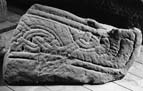
Object type: Hogback fragment [1]
Measurements: L. 72.4 cm (28.5 in) W. 33 > 17.8 cm (13 > 7 in) H. 41.9 cm (16.5 in)
Stone type: As Brompton In Allertonshire 3 (St Thomas)
Plate numbers in printed volume: Ills. 107–8
Corpus volume reference: Vol 6 p. 78-79
(There may be more views or larger images available for this item. Click on the thumbnail image to view.)
There is no end-beast; the prow-shaped termination has lost its upper protuberance. The plain ridge is rolled and flanked by smaller mouldings.
A (long) : Within a broad frame, a single panel is filled by a horizontal ribbon-beast, with at one point a double outline and diagonal hatching within it. Near the end of the panel the beast's body develops four downward lobes and divides into three roughly carved elements, the central one turning a right-angle. The undulating disposition of the animal allows for broad median-incised strands to interlace in remaining spaces and to interlock with the torso. Both the animal and the interlace are angular.
C (long) : As face A.
This is an atypical hogback which does not fit the typological classification (Chap. IV, p. 21). There may have been an animal-head terminal on the end where there is now damage. This is the only hogback from Brompton which does not have a substantial end-beast. Its side decoration also differs from that of other hogbacks in Allertonshire. The bound ribbon-beast is closer to those of the Ryedale school (Lang 1991, 41), though there is a passing resemblance to Lythe 29 (Ill. 573). The four-lobed fringe on the lower edge of the creature perhaps echoes Insular-Scandinavian details, like those of the Manx zoomorphic designs such as Braddan 135 (108) (Kermode 1907, 203–4, pl. LVII).
