Select a site alphabetically from the choices shown in the box below. Alternatively, browse sculptural examples using the Forward/Back buttons.
Chapters for this volume, along with copies of original in-text images, are available here.


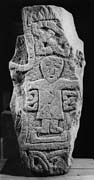
Object type: Part of cross-head [1]
Measurements: H. 61.7 cm (24.3 in) W. 26 cm (10.2 in) D. 20.5 > 15.1 cm (8 > 6 in
Stone type: As Brompton In Allertonshire 1 (St Thomas)
Plate numbers in printed volume: Ills. 71–4
Corpus volume reference: Vol 6 p. 73
(There may be more views or larger images available for this item. Click on the thumbnail image to view.)
A (broad) : A plate-head cross of type B8 with splayed arm and convex tip. Both lateral arms are broken off. The edge moulding is broad and flat, especially at the top. Stumps of the plate survive. The upper limb contains a roughly cut twin-link (closed circuit pattern B) and the face of the cross is occupied by a Crucifixion. Christ's head is spade-shaped with primitive incised facial features. He stands, wearing a long garment to his knees. His legs are close together and the feet out-turned. Below the feet is a straight horizontal filler with its ends turned up at right-angles. Close beneath his arms are the remains of crudely cut twin-links. All the cutting is picked work. Below the perimeter moulding, the topmost panel of the shaft has the box-points of closed circuit interlace in flat median-incised strand.
B (narrow) : Broken away. The stumps of the plate can be discerned.
C (broad) : The edge moulding is broad and flat. The face of the cross is filled with debased interlace in disorganised flat strand. Near the centre a filler approximates to a small boss.
D (narrow) : As face B.
A rustic response to Brompton's more accomplished plate-head crosses, this piece has no indication of template or grid in its construction. The standing clothed Christ is in the Irish position on the cross-head and has many Yorkshire parallels; for example, Ellerburn 8 in Ryedale (Lang 1991, 129, ill. 437).
