Select a site alphabetically from the choices shown in the box below. Alternatively, browse sculptural examples using the Forward/Back buttons.
Chapters for this volume, along with copies of original in-text images, are available here.


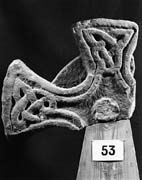
Object type: Part of cross-head [1]
Measurements: H. 33 cm (13 in) W. 35 cm (13.7 in) D. 14.5 > 10.2 cm (5.7 > 4 in)
Stone type: Fine-grained ferruginous, feldspathic, deltaic sandstone. The sub-angular grains are poorly sorted. Brown–strong brown (7.5YR 5/4–5/6). Stone provenance as Brompton In Allertonshire 1 (St Thomas)
Plate numbers in printed volume: Ills. 66–70
Corpus volume reference: Vol 6 p. 72
(There may be more views or larger images available for this item. Click on the thumbnail image to view.)
A plate-head cross of type E10, with very widely curving arm-pits and expanding arms with convex tips. The upper and left lateral limbs survive. The edge moulding is modelled, almost a roll in places. In the centre is a defaced domed boss with clear ground around it hacked back with a punch. Each limb has a 'Brompton loop' in well-modelled strand; the connecting strands lie close to the edge moulding and have a fleshy appearance. The loop in the upper arm is poorly accommodated
B (narrow) : Broken away.
C (broad) : Identical with face A.
D (narrow) : Worn and plain.
E (top) : Within a modelled edge moulding, the arm-tip panel is filled with four stages of closed circuit interlace in modelled strand.
One cannot be certain that face E was indeed the upper limb. The present disposition of the fragment might be turned through 90 degrees, giving a longer upper limb. This cross, very like Northallerton 9 (Ills. 685–6), demonstrates the variety of ring and plate heads within the Brompton school. There is less horror vacui in the interlace design, with clear ground above the boss. It is an Anglian cross-form with the addition of a Brompton plate.
