Select a site alphabetically from the choices shown in the box below. Alternatively, browse sculptural examples using the Forward/Back buttons.
Chapters for this volume, along with copies of original in-text images, are available here.


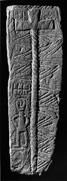
Object type: Part of grave-cover
Measurements: L. 82 cm (32 in); W. 28 > 15.5 cm (11 > 6 in); D. 4 cm (1.5 in)
Stone type: Medium-grained red sandstone (St Bees sandstone)
Plate numbers in printed volume: 222 - 3
Corpus volume reference: Vol 2 p. 89
(There may be more views or larger images available for this item. Click on the thumbnail image to view.)
Only the broad upper surface carries decoration and this is surrounded at the top (and possibly originally on the other sides) by a cabled moulding. At the top of the slab is a cross-head of type B6, its cabled stem running the length of the centre of the slab; at the centre of the head is an incised ring surrounding six (or more) shallow drilled holes. Above the left arm of the cross is an incised rectangle containing an incised linear cross. Below the right arm, running down the slab, are incised lines forming chevrons. Similar chevrons occur below the left arm but are succeeded, half-way down the slab, by an incised grid above a human figure, who is carved in shallow relief; his hands are placed on his hips and the feet are shown in profile. Facial features and the neckline of his short garment are lightly incised.
Whilst this slab, like no. 3, has Merovingian analogues, it is likely that its decoration represents a late development. The chevron pattern, like that on Burton in Kendal 3, is probably an attempt to suggest interlace, whilst the cruciform decoration can be compared with that on slabs from Kirkclaugh and Anwoth, Kirkcudbrightshire, which both emerged from eleventh- to twelfth-century contexts (Collingwood 1927a, fig. 226). The decoration at the centre of the head suggests familiarity with encircled bosses on stone or metalwork crosses.
