Select a site alphabetically from the choices shown in the box below. Alternatively, browse sculptural examples using the Forward/Back buttons.
Chapters for this volume, along with copies of original in-text images, are available here.


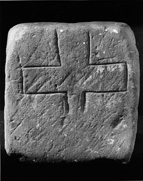
Object type: Grave-marker
Measurements: H. 21.5 cm (8.5 in); W. 20.5 cm (8 in); D. 11.5 cm (4.5 in)
Stone type: Medium-grained red sandstone (St Bees sandstone)
Plate numbers in printed volume: 224 - 6, 229
Corpus volume reference: Vol 2 p. 88-89
(There may be more views or larger images available for this item. Click on the thumbnail image to view.)
A (broad): Incised outline cross of type A1 with the end of the vertical arms left open. Three lightly incised lines converge, arrow-like, on the upper arm-pits.
B (narrow): Traces of two legs, with feet set in profile, and the lower body of a man in shallow relief.
C (broad): No decoration visible.
D (narrow): Incised ornament consisting of a single horizontal line on which converge three incised lines from above and below.
Though this kind of decoration would not be out of place in a Merovingian cemetery it is probably best compared with the ornament on the Viking-period slab (no. 4) from this site (where the human figure also has feet set in profile). The motif on face D could be a simplified version of the one seen on the Dearham runic stone (Calverley 1899a, 116) or merely a misunderstanding of a cruciform pattern. The lines above the cross-arms on face D may be intended as stylized birds or angels; both are frequently placed in this position on Crucifixion scenes.
