Select a site alphabetically from the choices shown in the box below. Alternatively, browse sculptural examples using the Forward/Back buttons.
Chapters for this volume, along with copies of original in-text images, are available here.


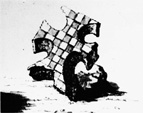
Object type: Cross-head
Measurements: Unobtainable
Stone type: Unobtainable
Plate numbers in printed volume: 117 - 18
Corpus volume reference: Vol 2 p. 72-73
(There may be more views or larger images available for this item. Click on the thumbnail image to view.)
Head, type B10, and possibly part of the shaft of a cross.
A (broad): The cross is depicted as lying on the ground, half propped against a piece of stone. The end of the right-hand arm is broken, and the base of the lower arm is broken in an upward curve. The whole face is covered by chequers which are shown as alternately shaded, presumably to indicate that they are alternately raised and sunken. The edges of the arms are not finished with mouldings, but are shown with a ragged line.
The shape of the head is not that of an early type, such as Collingwood proposed in his reconstruction of the lost head of no. 1 (Collingwood 1927a, 85, fig. 102). Baldwin Brown also assumed that the latter would have been of a different shape to that in the drawing under consideration here (Brown 1921, 117, fig. 10). Whether or not this is indeed a depiction of the head of no. 1, its shape would be perfectly appropriate in a Cumbrian setting in the Anglian period (Introduction, p. 13), and may be compared closely with Irton 1.
The artist's rendering of some of the panels of ornament on the shaft, when checked against the surviving monument (no. 1), are not accurate in the same way that, for example, Armstrong's depiction is not (Cook 1914a, 18). The drawing corresponds to Nicolson's account of 1685, in that the uppermost figure on face A is shown as '. . . the B.V. with the Babe in her arms . . .' (Nicholson 1685, 1287). Nevertheless, the one panel that is an accurate rendering is the chequers, which lends some plausibility to his rendering of this head.
It is unlikely that the artist would have made up a head, since no later author depicted an imaginary head lying alongside the cross. Interestingly, the text that accompanied Armstrong's plate (Armstrong 1775) says '. . . besides there has been on the top a cross, now broken off, part of which may be seen as a gravestone in the same churchyard . . .'. (This reference to part of the cross-head surviving as a gravestone is repeated in Gough's Camden (Camden 1806, III, 455).) If this is an eighteenth-century drawing (as it seems to be by its style), then this is interesting support. The possibility of a chequered head is strengthened by the illustration in Cox (1914, 11), which Cook describes as 'imaginary' (Cook 1914a, 11). An additional interesting point about that illustration is that the runic inscription, in the form quoted by the earlier antiquaries (Page 1960, 54–7), may have appeared on a block (epistylium) below the cross head. This may be artistic licence, but it is noteworthy that Baldwin Brown, in attempting to square Cotton's measurements with the actual dimensions at the top of the shaft, fitted a collar or square moulding (which he felt could be called an epistyle) around the top of the shaft (Brown 1921, fig. 10). Other commentators have, however, seen the epistyle as referring to the whole head (see Page's Discussion of Bewcastle 7, below).
His reasoning is as follows: the dimensions given in BL MS. Cotton Domitian A. xviii, fol. 37 are: length, 16 in; 'thickness', 4 in; breadth at upper end, 12 in. This Brown considers '. . . implies a lesser dimension at the 'lower' end, and suggests a slanting fracture that may have taken off some inches from the original breadth . . .' (Brown 1921, 116–18, fig. 10). This would fit the appearance of the break (see Ill. 92). Thereafter Brown's argument becomes unnecessarily complicated. My own measurements of the top of the cross taken from scaffolding in 1967 are: W. face, 16 in; E. face, 16 in; S. face, 13.75 in; N. face, 13 in. These correspond quite well with those of the Cotton MS. If there were a collar at the top of the shaft to hold the dowelled head in place then the watercolour (Ill. 118) shows the damage done by knocking off the dowell and one must assume the collar or epistyle had been taken away. Otherwise one has to imagine that what was sent to Arundel was a split cross-head, since a thickness of 4 in is less than half the shaft depth. That supposition might be supported by the statements in Armstrong and in Gough's Camden that part of the cross-head was serving as a gravestone (see above). It seems possible, then, that there was a head, held in the way that Brown deduced and of the form illustrated in Cox, which may be the one depicted in the Antiquaries' drawing (but see Page's Discussion of Bewcastle 7).
