Select a site alphabetically from the choices shown in the box below. Alternatively, browse sculptural examples using the Forward/Back buttons.
Chapters for this volume, along with copies of original in-text images, are available here.


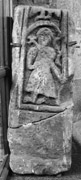
Object type: Part of shaft
Measurements: H. 113 cm (44.5 in); W. 37 cm (14.6 in); D. 21 cm (8.3 in)
Stone type: Very pale orange (10YR 8/2), poorly sorted, clast-supported, quartz sandstone with some fine cross bedding at right-angles to front face; pink feldspars are common. The sub-angular to sub-rounded grains range from 0.2 to 2 mm across, but are dominantly in the range 0.4 to 0.8 mm. Millstone Grit Group, Carboniferous (C.R.B.)
Plate numbers in printed volume: Ills. 531–4
Corpus volume reference: Vol 13 p. 281-283
(There may be more views or larger images available for this item. Click on the thumbnail image to view.)
All four edges of the shaft seem to have been bounded by a plain wide flat angle moulding which terminates above the base of the stone, although on B and D much of the angle moulding was lost when C was cut back for reuse. The lower portion of each surviving face is plain, but dressed.
A (broad): The angle mouldings are inset with plain roll mouldings that form the remains of two panels, the lowermost being bounded horizontally at the bottom, and by an arch above that springs from the left-hand inner moulding, but the edge of the right-hand moulding evolves into a meandering strand that terminates by the waist of the figure that fills the panel. This figure, who wears a full-length, flared robe, faces forwards, while the feet, which are slightly curved, are turned to the left. The head is a rounded oval, and indentations for the eyes are still visible. The shoulders are well rounded and slightly hunched. The figure’s right arm is sharply bent at the elbow and crosses the body to support a staff-cross that crosses the body diagonally to pass over the right shoulder and terminate at the edge of the inner roll moulding on the left, at the point of the break in the stone. There is no sign of the left arm. In the incomplete panel above, is the drooping hemline of a full-length robe, and a pair of feet, turned to the left, resting on the upper edge of the arched moulding dividing the two panels.
B (narrow): The uppermost portion of the panel, contained by the angle mouldings and a plain flat horizontal moulding running across the top of the dressed lower portion of the shaft, is filled with the paired terminals of a four-strand interlace pattern. Filling the remainder of the panel is a plant-scroll with three berries contained in the single turn of the uppermost spiral. Below, the form of the plant is unclear above the break in the stone, but the main stem forms a complete loop containing four berries, immediately below the uppermost spiral.
C (broad): Cut back to form feeding trough
D (narrow): The panel, contained by the angle moulding and a horizontal roll moulding above the lower dressed area of the shaft, is filled with an interlace pattern of interlocking figure-of-eight loops, above which are the remains of a creature with a wide flat ribbon body outlined by thin mouldings.
As it survives, the shaft–of which this stone constitutes the lower portion–was decorated with figural ornament on the broad face, with single figures set in individual panels running the length of the shaft, and zoomorphic and foliate decoration set on the narrow sides. Although incomplete, this apparent organisational intent is supported by the way the decoration is laid out, with the panels clearly demarcated by plain well-formed roll mouldings. It is unclear, given the broken condition of the piece, whether the shaft was originally set in a socket stone up to the lowermost panel moulding, but the dressed condition of shaft below on A, and the apparent flat shallow angle mouldings on all three surviving faces suggests this was not the case: there is no sign of any carving or light incisions, implying that the lower part of the shaft was deliberately left plain.
The zoomorphs and plant-scrolls provide some diagnostic features. The scroll on B, for instance, is distinguished by its loose structure with hanging tendrils, and absence of fruit and leaves, features not unlike those found on Sandbach Market Square 1 (Bailey 2010, 99–113, ill. 249: see Ill. 662), while the remains of the interlace pattern above is an admixture also found on the Sandbach shaft as well as Bakewell 4 and 34 (Ills. 21, 92), although it is not arranged in same manner: the scroll and interlace at Chesterton are discrete entities; they do not morph into each other as they do at Sandbach and Bakewell.
The figure on A has been by discussed by Hawkes (2002a, 140) in conjunction with profile cross-bearing figures surviving elsewhere in the West Midlands: at Sandbach (Market Square 1: Bailey 2010, 99–113, ill. 267), in Cheshire, Bakewell (14) in Derbyshire, and Leek (3), and possibly Eccleshall (1) in Staffordshire (Ills. 40, 569 and 538). In the corpus of Anglo-Saxon sculpture these depictions of profile, cross-bearing figures are unusual, and form a discrete group, suggesting that the sculptural activities involving the carvings–at least those at Leek and Bakewell–looked to earlier sculptural campaigns at Sandbach (Hawkes 2002a, 140–1; Plunkett 1984, 135–6). The figure at Chesterton, however, is clearly forwards facing, despite the way his feet are turned in profile to the left (a characteristic of the figural style found across the region: Plunkett 1984, 133), differentiating him significantly from the other cross-bearing figures in the region. Nevertheless, in keeping with the profile cross-bearing figures, he does display the distinctive figural style also found at these sites: the sharply arched feet and pronounced shoulder/upper arm are characteristics featured at Sandbach where the ovoid head, like that at Chesterton, is standard, as is the tendency to depict skirts sharply drooping at the corners to mirror the shape of arched frame below–a detail preserved in the upper panel at Chesterton, as well as Norbury (1), Derbyshire, and Alstonefield (2), Staffordshire (Ills. 234, 485-6). Likewise, the figure is associated with a small serpentine feature over his shoulder, a detail included elsewhere at Leek (3) and Alstonefield (2) (Ills. 569, 485-6). Overall, therefore, the figural style and associated motifs suggest the piece reflects a local regional repertoire. While the forwards-facing stance of the Chesterton figure, and the manner in which he holds a staff-cross diagonally across his body, distinguishes him from the other cross-bearing figures in the region, it also identifies him as a specific iconographic type, being isolated within the panel and not included as part of a narrative scheme, like the ascending Christ at Wirksworth (5) where Christ bears the staff-cross of the Resurrection and is accompanied by angels and witnesses to the theophany. Rather, the iconic depiction of the Chesterton figure with the staff-cross identifies him as being closely related to figures of Christ Triumphant, early established in Christian art (by means of adapting the iconography of imperial triumph: Grabar 1936, 237), to depict Christ’s victory over death (Hawkes 1989, 495-6).
Distinct from the Chesterton scheme, however, images of Christ Triumphant tended to illustrate Christ bearing the staff cross over his shoulders behind his head, and usually featured a set of beasts, including a serpent, trampled beneath his feet (e.g. fifth-century mosaic scheme, archiepiscopal chapel, Ravenna: Bovini and Pierpaoli 1991, pl. 34). Despite its well-established iconography, which was reproduced in an Anglo-Saxon context on the late eighth-century Genoels Elderen diptych (Webster and Backhouse 1991, 180–3, cat. 141), the scheme was adapted within Insular contexts to serve other purposes. In the early ninth century, Christ bearing the staff-cross across his body was used to portray Christ of the Second Coming in the Turin Gospels (Turin, Bibl. Naz. Cod. O. IV. 20, fol. 2a: Alexander 1978, 80–1, cat. 61, pl. 280), and earlier, in the mid eighth-century Durham Cassiodorus (Durham Cathedral Library, MS B.II.30, fol. 172b), the iconography of Christ Triumphant was adapted to feature David as Christ, bearing a spear diagonally over his body–rather than a staff cross–and trampling a double-headed serpent (Webster and Backhouse 1991, 126–7, cat. 89; Bailey 1979, 11, pl. 2). Against this iconographic background, it may be that the sinuous serpentine feature included in the panel at Chesterton was intended to denote the serpent normally included in scenes of Christ Triumphant. The cross-bearing figure on Leek 3 is also accompanied by serpentine creatures, suggesting that the Road to Calvary scheme on which it was based, was adapted to communicate Christ’s triumph over death (in form of serpent), at the crucifixion (Hawkes 2002a, 140). This is, in effect, the iconographic significance of Christ Triumphant, trampling the beasts.
Overall, therefore, it seems likely that the Chesterton scheme can be understood in the same light: as symbolising Christ’s victory over death and the forces of evil, with reference to the Crucifixion, the Harrowing of Hell and the Resurrection. The figural iconography suggests it was produced within the context of ecclesiastical sculptural activity which was, to some extent, looking to early ninth-century iconographic schemes, such as those of Sandbach Market Square 1, but was adapting those models. It is probably best viewed within the context of a group of centres within the region, including those at Leek, Alstonefield and Bakewell (see also Hope 1).
