Select a site alphabetically from the choices shown in the box below. Alternatively, browse sculptural examples using the Forward/Back buttons.
Chapters for this volume, along with copies of original in-text images, are available here.


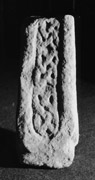
Object type: Upper section of round-shaft [1]
Measurements: H. 52 cm (20.5 in); W. 22 > 18 cm (8.6 > 7.1 in); D. 21 > 14 cm (8.2 > 5.5 in)
Stone type: Pale red (10R 6/2), poorly sorted, feldspathic sandstone, with quartz predominating, but with some concentrations of feldspar clasts. Although generally fine- to medium-grained (up to 0.5 mm), the rock contains some sub-angular quartz clasts of up to 1 mm. Namurian sandstone consistent with the Ipstones Edge Sandstones and associated sandstones, Morridge Formation, Millstone Grit Group, Carboniferous (R.T.)
Plate numbers in printed volume: Ills. 495–8
Corpus volume reference: Vol 13 p. 269-270
(There may be more views or larger images available for this item. Click on the thumbnail image to view.)
A (broad): Decorated with a three-strand simple interlace that terminates at the bottom, probably as a closed loop, although this part is damaged; the upper part of the pattern is truncated. There are edge mouldings on both sides of the pattern which are badly eroded and chipped but appear to be roll mouldings.
B (narrow): Decorated with a simple line or key pattern which is damaged at the top and eroded elsewhere. Again, there are edge mouldings on each side but these are damaged and chipped. The pattern terminates at the bottom, below which is a broken and dressed-off area.
C (broad): Badly damaged, weathered and eroded, the decoration is difficult to decipher, but it appears to comprise another three-strand plait or simple interlace. Again, there are edge mouldings on each side of the pattern, which possibly terminates in a closed loop, but this area is quite damaged.
D (narrow): This face is decorated by a two-strand simple interlace which appears to terminate at the bottom where the stone is damaged through subsequent dressing-off. Eroded edge mouldings survive on each side; that on the left appears to have been of the cable type although this is not entirely certain.
This stone appears to be part of the upper, rectangular-sectioned, portion of a round-shafted cross. It is similar to examples elsewhere in the region and in eastern Cheshire (e.g. Disley Lyme Handley 1–2; see Bailey 2010, 78–9, ills. 162-70), which are highly decorated on their upper portions, whereas the lower, cylindrical portion is often undecorated, being separated from the rectangular top section by a single or double collar moulding (see e.g. Ilam 2, Ills. 551-2, 554-5). As with Alstonefield 6, many round cross-shafts are, in fact, ovoid in section and this is transferred to the upper sections to produce a rectangular cross-section, as in this case. And, as already suggested, such round-shafted crosses may well be reused Roman milestones, where the lower sections were left relatively untouched (i.e. plain), with the upper portions cut back to produce tapered, rectangular and highly decorated areas. The interlace patterns on three of the faces of this stone appear irregular, suggesting that the sculptor or designer may not have been highly skilled.
