Select a site alphabetically from the choices shown in the box below. Alternatively, browse sculptural examples using the Forward/Back buttons.
Chapters for this volume, along with copies of original in-text images, are available here.


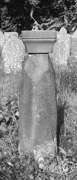
Object type: Round-shaft (reused as sundial) [1]
Measurements:
H. (to bottom of sundial) 105 cm (41.3 in)
W. 40 > 19 cm (15.75 > 7.5 in); D. 37 > 17 cm (14.6 > 6.7 in)
Stone type: Very fine, well-sorted, feldspathic sandstone. Generally the grains in this red to reddish-brown (2.5YR 5/6–2.5YR 5/4) sandstone range only up to 0.2 mm, but it does contain sporadic clasts of up to 1 mm. Namurian sandstone consistent with the Ipstones Edge Sandstones, Morridge Formation, Millstone Grit Group, Carboniferous (R.T.)
Plate numbers in printed volume: Ill. 494
Corpus volume reference: Vol 13 p. 268-269
(There may be more views or larger images available for this item. Click on the thumbnail image to view.)
This is an ovoid-sectioned cross-shaft of the type generically referred to as a ‘round shaft’ (type g: Cramp 1991, xiv, fig. 1). As such, there are no clear faces except at the top where it has been cut into four roughly-shaped tapering flat surfaces (c. 15–20 cm (5.9–7.9 in) in height) which terminate beneath the sundial. These are separated from the cylindrical shaft, which is not entirely symmetrical, by a rolled collar moulding, parts of which are missing. The shaft now has a smooth appearance, probably through weathering, and the upper portion, above the collar, is undecorated.
Although incomplete, this clearly represents the remains of a round-shafted cross of which there are several examples in the region (e.g. Ilam 2, Ills. 551-2, 554-5; Bakewell 25, Ills. 57-60; Brailsford 1, Ills. 127-30). Pape regarded this monument type as a separate group and, indeed, included them in a separate paper from those of the more common rectangular cross-sectioned shafts (Pape 1945-6). However, other examples of round-shafts where decoration is present, suggests that this distinction is potentially misleading as the monument form is the only factor distinguishing them.
Many of the round-shafted crosses are ovoid in section and, in this region, tend to have plain lower shafts. The Roman road from Derby to Buxton and Manchester, the present A515, passed close to Alstonefield and it is probable that this shaft, and others in the vicinity, represent reused Roman milestones (cf. Fig. 35, p. 86). The roughly cut nature of the squared upper section may mean that the collar moulding below was damaged when this was struck. While it is possible that the flat surfaces were squared off when the sundial was added, they are more weathered and in a different cut from the sundial above. This strongly supports the suggestion that the shaft represents a pre-existing column that, intended to be converted into a round-shafted cross shaft, was abandoned when the carving of the upper section damaged the collar moulding, leaving the monument unfinished. Alstonefield 11 below represents another example of a possibly unfinished shaft.
