Select a site alphabetically from the choices shown in the box below. Alternatively, browse sculptural examples using the Forward/Back buttons.
Chapters for this volume, along with copies of original in-text images, are available here.


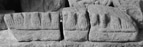
Object type: Remains (of unidentified monument) in three pieces [1]
Measurements:
a. H. 20 cm (7.9 in); W. 34 cm (13.4 in); D. 17 cm (6.75 in)
b. H. 20 cm (7.9 in); W. 16 cm (6.25 in); D. 15 cm (6.2 in)
c. H. 20 cm (7.9 in); W. 30 cm (11.75 in); D. 18 cm (7 in)
Stone type: Poorly-sorted, pink to pinkish-grey (7.5YR 7/2–7/4) feldspathic sandstone. Quartz clasts range from under 0.5 to 3 mm. Kinderscout Grit or Ashover Grit, Millstone Grit Group, Carboniferous (R.T.)
Plate numbers in printed volume: Ills. 99–102
Corpus volume reference: Vol 13 p. 143-144
(There may be more views or larger images available for this item. Click on the thumbnail image to view.)
A (broad): All three pieces are traversed by a thin roll moulding below which the recessed plane of the stone is plain but finely dressed. The carved decoration above the roll moulding comprises a series of forward-facing human feet interspersed by vertical mouldings.
a. Filled with five feet, the first two on the left being separated from the others by a plain roll moulding that rises vertically from the horizontal moulding.
b. Contains two feet with the remains of a vertical moulding or a third foot surviving by the break on the left of the stone. The vestiges of a hemline are visible to left of first complete foot on left.
c. Contains the remains of three feet. One, on the left, is separated from the other two by a vertical moulding.
B and D (narrow) and C (broad): a–c. Broken
The carved remains of these stones suggest that the original scheme consisted of standing figures wearing full-length robes who were separated by vertical mouldings. The fact that more than two feet not separated by a vertical moulding survive on b, further implies that the figures were at least arranged in pairs, while the number of feet surviving also suggests that a minimum of eight to ten figures, and more probably twelve to thirteen were originally depicted.
The figures most commonly depicted in early Christian art as full-length standing figures separated by columns are the twelve apostles, who are preserved in this manner elsewhere in Anglo-Saxon England, on the early ninth-century column at Masham, Yorkshire, where they flank the enthroned figure of Christ in Majesty (Lang 2001, ill. 602). It is a scheme that flourished under the patronage of Constantine in fourth-century Rome, and enjoyed a revival there at the turn of the ninth century as part of a self-conscious Constantinian renaissance (Hawkes 2002b, 345). Nevertheless, other schemes of standing figures also survive. The so-called Hedda Tomb at Peterborough in Cambridgeshire, dated by Bailey to the late-eighth century, displays twelve standing figures: four apostles with Christ and the Virgin Mary on one side, and six apostles on the other (Bailey 1990, 8–11, fig. 4).
Regardless of the number of figures originally displayed at Bakewell, the size of the feet indicates that they probably stood approximately 1 m (39 in) high. This implies a monument of some considerable size, while the disposition of the feet indicates it is unlikely to have formed the top of a coped monument as suggested by previous commentators (Routh 1937a, 15; 1937b, 17; see discussion of Bakewell 34). Rather, the arrangement of pairs of standing, forwards-facing, full-length figures, suggests that the monument formed either a carved stone frieze or panel, or as suggested by Cramp (1977, 218–19), the side of a shrine or sarcophagus, which, if it were decorated with twelve to thirteen standing figures, would probably have been in the region of 2 m (79 in) wide.
The way the feet ‘hang’ so distinctively, is also suggestive: it is the pose featured repeatedly for the forwards-facing figures on Wirksworth 5 (Ills. 446-55), and as such, is unlike the more coherent, three-quarter turned and profile pose used for the feet of forwards-facing figures at Peterborough (and elsewhere in the eastern Midlands), or indeed the full-length forwards-facing figures preserved elsewhere in the Peak District: on Bakewell 1 and Bradbourne 1. Whether this implies a relationship between this monument and that at Wirksworth cannot be ascertained, but as other pieces preserved at Bakewell (9 and 11) are likely to have emerged from the centre responsible for the production of Wirksworth 5, it is possible that this monument might be considered within the same milieu. However, the figural style of the carvings on Bakewell 34 is distinctly unlike that of Wirksworth 5 and the stones related to it, being characterised by well-modelled haloes and figures wearing plain robes (Ills. 91-5). But, despite their modelling, their feet are nevertheless shown in strict profile, rather than the subtle complex poses adopted for profile and three-quarter turned figures in early Christian models. Thus, the awkwardly forwards-facing pose of the feet on Bakewell 37 may well be regarded in the light of the disposition of the figures on Bakewell 34, rather than those preserved at Wirksworth.
