Select a site alphabetically from the choices shown in the box below. Alternatively, browse sculptural examples using the Forward/Back buttons.
Chapters for this volume, along with copies of original in-text images, are available here.


Object type: Part of shaft [1]
Measurements: H. 28 cm (11 in); W. 32 cm (12.5 in); D. 28 cm (11 in)
Stone type: Poorly sorted, greyish orange to very pale orange (10YR 7/4–8/4) feldspathic sandstone. Clasts from 0.1 to 4 mm diameter. Kinderscout Grit or Ashover Grit, Millstone Grit Group, Carboniferous (R.T.)
Plate numbers in printed volume: Ills. 44–5
Corpus volume reference: Vol 13 p. 125
(There may be more views or larger images available for this item. Click on the thumbnail image to view.)
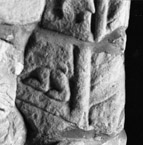
The corner between the two visible faces A and B is marked by a narrow inner roll moulding on each side, and the same well-formed, distinctive cable moulding seen on Bakewell 12 and 15, being formed of strands with a central concave depression, set at an angle.
A (broad): The inner roll moulding extends at an angle across to the left of the stone to form a triangular-shaped frame containing the lower portions of a profile figure whose feet, turned to the left, and legs emerge from the hemline of a robe that droops sharply at each corner.
B (narrow): Centrally, below the upper break is a small curved feature. Below this, and to the left, is a prominent pellet. The remainder of the panel is filled with a series of flat parallel mouldings curving up to the right that are contained above by a wide inverted U-shaped element.
C (broad) and D (narrow): Broken
The shape of the panel on A suggests a pendant triangle comparable to those featured on Sandbach Market Square 1 and 2. The cable angle moulding and inner roll moulding, the prominent pellet featured on B, and the drooping corners of the hemline of the robe worn by the figure on A are also details shared by the stones at Sandbach, as well as Bakewell 12 and 15. Furthermore, the curved feature of B, along with the parallel flat mouldings sweeping up to the right, are details found at Sandbach: in the tendrils linking the Transfiguration and Traditio Legis scenes on Sandbach Market Place 1, and the robe of Christ depicted in both those scenes.
Indeed, the complete schemes preserved at Sandbach which display these details provide an explanation (in the light of Bakewell 15) of what the schemes on Bakewell 16A and B may once have depicted. Thus, the figure in what can be identified as the pendant triangle on A can perhaps best be understood as one of the terminal figures of the scheme depicted on Bakewell 15B: the spiritual ladder, which on Sandbach Market Square 2 terminates in figures set in triangles comparable to that on 16A (Ill. 645). And, while the details of B are too fragmentary to identify with any certainty, they might be understood as part of a half-length figure sweeping up to the right, such as occurs in the pendant triangles on both Sandbach Market Square 1 and 2. Certainly, the two faces suggest that the piece originally formed part of the lower part of a cross-shaft and displays many of the organisational and decorative features found in that position on the crosses at Sandbach (Bailey 2010, 24, 96).
