Select a site alphabetically from the choices shown in the box below. Alternatively, browse sculptural examples using the Forward/Back buttons.
Chapters for this volume, along with copies of original in-text images, are available here.


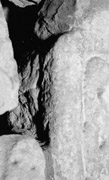
Object type: Part of shaft [1]
Measurements: H. 48.5 cm (19.1 in); W. 32 cm (12.5 in); D. 27 > 26 cm (10.6 > 10.25 in)
Stone type: Predominantly fine-grained, though in places poorly-sorted, pink feldspathic sandstone. Quartz clasts up to 0.5 mm present, as are some mica flakes and sporadic black metallic grains. Millstone Grit Group, Carboniferous (R.T.)
Plate numbers in printed volume: Ills. 38–40
Corpus volume reference: Vol 13 p. 122-123
(There may be more views or larger images available for this item. Click on the thumbnail image to view.)
The carving on A, B and D is contained by wide flat mouldings set vertically and horizontally; on B these are inset with a thin continuous roll moulding.
A (broad): A panel of wide, flat four-strand interlace carved in deep relief is set in a curved-headed panel.
B (narrow): The decoration, contained in an arched panel, consists of the upper portion of a figure, carved in lower relief than that used for the interlace on A. Awkwardly positioned, the figure is set in profile, its head discernible, centrally placed and looking to the right, at the top of the panel. One arm emerges from behind the neck (on the left), to extend, ribbon-like, around the top of the head and in front of the face where it widens to terminate in a large hand that grasps a well-formed staff-cross held diagonally across the body, such that the cross-head extends over the ‘shoulder’ and bends slightly to fill the space in the arch behind the figure’s head. The other arm, also attenuated, extends down the left-hand side of the panel, widening out at the elbow, to cross the body at ‘waist’ height, and grasp the staff-cross in an exaggeratedly large hand, placed just below the other. The lower portion of the figure is undecorated, although the carved surface is dressed. The area of the upper torso, below the protruding chin of the profile head, has been rendered as a large pellet, formed by the deeply incised lines defining the ‘upper’ arm and the staff of the cross.
C (broad): Inaccessible
D (narrow): Largely inaccessible, but some carving is visible at the top of the stone in the gap between Bakewell 14, 8 and 9. It consists of a small portion of a strand of either interlace or plant-scroll.
The remains of the figure on B, although distorted, can be understood to depict a profile figure with a staff-cross held over the right shoulder by both hands, the left arm emerging from around the back of the head. As such, it represents one of a small group of such figures all located in this region—Leek 3, Ill. 569 (see also Hope 1, Ill. 214). Generally, in Anglo-Saxon sculpture, figures bearing staff-crosses over the shoulder face forwards (e.g. Christ ascending on Wirksworth 5, Ill. 453, or Christ in Majesty on Chesterton 1, Ill. 533). This figure, and that at Leek (and Hope), however, are in profile and have, in addition, attenuated necks and slightly stooped shoulders; they are also found in association with prominent pellets. Here, this motif occurs in the angle moulding between A and B, while the area of the chest between the staff-cross and left arm has been articulated as a pellet. Elsewhere, it has been suggested (Hawkes 1998, 41-2; 2002a, 139-41) that these Derbyshire and Staffordshire figures derive from the relatively rare iconography of the Road to Calvary featured on the early ninth-century cross of Sandbach Market Square 1 where Simon of Cyrene bearing the cross to Calvary in the company of Christ is interspersed by pellets and characterised by a slightly stooped posture, an attenuated neck and rather limp staff-cross held drooping over his shoulder (Bailey 2010, 111–12, ill. 267; see Fig. 32, p. 79). Here at Bakewell it seems that this figure type, removed from a narrative context, has been utilised to convey the ideas normally associated with the forwards-facing image of Christ bearing a staff-cross: that of the majesty of the resurrected Christ, the staff-cross itself being the symbol of the resurrection. As such, it likely represents a later response to the iconographic programme displayed in the ninth-century carvings at Sandbach, and so is probably best situated in a later ninth or tenth-century context.
