Select a site alphabetically from the choices shown in the box below. Alternatively, browse sculptural examples using the Forward/Back buttons.
Chapters for this volume, along with copies of original in-text images, are available here.


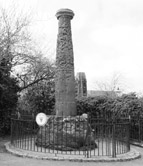
Object type: Column with capital
Measurements:
Overall: H. 450 cm (14 ft 9 in) (after Rix 1960, 72)
Base to top of register A: H. 163 cm (64 in)
B: H. 48 cm (19 in)
C: H. 18 cm (7 in)
D: H. 48 cm (19 in)
E: H. 43 cm (17 in)
F: H. 43 cm (17 in)
G: H. 30.5 cm (12 in)
Capital: H. 23 cm (9 in)
Diameter: 76 > 56 cm (30 > 22 in)
(Measurements confirmed for Base to top of A, B, and C)
Stone type: Pale red (5R 6/2), moderately sorted, medium-grained, clast-supported, quartz sandstone. Grain size varies from 0.4 to 2 mm, but is mainly in the range 0.5 to 0.7 mm. Clasts vary from sub-angular to rounded, but are dominantly sub-angular to sub-rounded. Clasts are mostly clear quartz, but there are scattered, sub-rounded, white, feldspars up to 1 mm across. Helsby Sandstone Formation, Sherwood Sandstone Group, Triassic (C.R.B.)
Plate numbers in printed volume: Ills. 612–26, 664–5; Fig. 50
Corpus volume reference: Vol 13 p. 310-315
(There may be more views or larger images available for this item. Click on the thumbnail image to view.)
Due to the cylindrical nature of the monument its carving will be described register by register, from the lowest (A) to the uppermost (G), as set out by Rix (1960, pl. XI: see Fig. 50), rather than face by face as is the norm for monuments of square or rectangular section. The lower part of the column is undecorated.
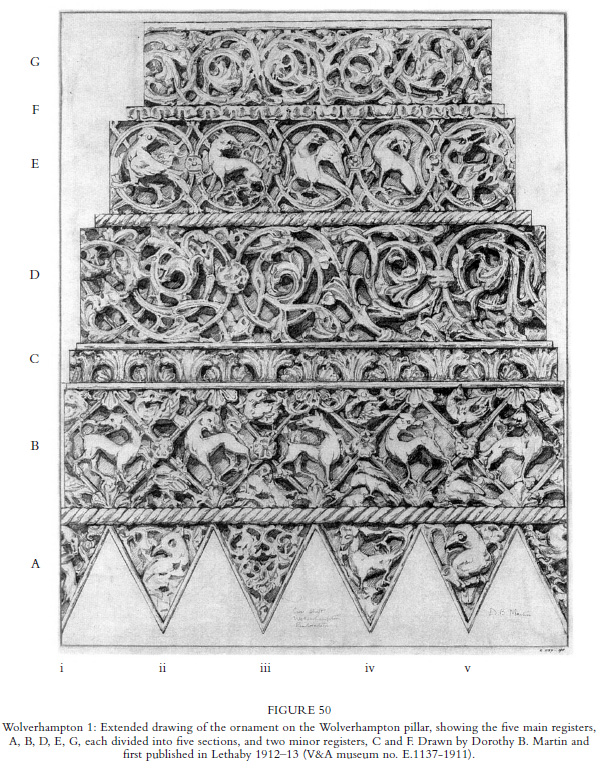
A (lowermost register): The five pendant triangles (i–v) of which the lowermost register is composed, is bound along the top by a cable moulding about 6.5 cm (2.5 in) wide which encircles the column. The triangles themselves are framed by thin plain mouldings containing what appears to have been an admixture of foliate and zoomorphic ornament in each. The western pendant, Ai (Rix 1960, no. 5) contains the remains of a back-turned profile quadruped with an elongated body, well-formed hind-quarters and an heraldic chest, with all four feet perched on a branch running along the left-hand side of the triangle, feeding from a foliate element in the upper right-hand corner. The contents of the pendant triangle Aii, to the right (Rix 1960, no. 4) are extremely damaged but appear to have contained only foliate decoration; this is certainly the interpretation given in the 1913 drawing (Fig. 50). Likewise, the pendant triangle Aiii (Rix 1960, no. 3) seems to have contained only foliate ornament with no beast displayed in the interlacing pattern formed by the branches. The penultimate triangle, Aiv (Rix 1960, no. 2) is also badly worn, but it does appear to preserve the remains of a profile beast, two of whose legs fill the lower angle of the triangle, and whose body traverses it horizontally, the head–possibly that of a bull–having been placed in the upper left-hand corner, and one leg extended towards a branch running along the left edge of the panel; further foliate ornament appears to have filled the upper right-hand corner. Triangle Av (Rix 1960, no. 1) is sufficiently well preserved to show the remains of a back-turned creature, possibly a bird, who perches on a branch lying across the lower portion of the triangle; the body is well formed and the head turned back to the left to feed on a foliate element resembling a spear-shaped leaf emerging from the foliation in the upper corner; the opposite corner is similarly filled with foliate ornament.
B: Above the cable moulding bounding the upper edge of the pendant triangles is a series of lozenge-shaped frames formed by narrow plain mouldings, the intersections and upper and lower angles all being marked by rosette-shaped foliate motifs. The lowermost points of the lozenges rest at the point where, below, each pendant triangle meets the cable moulding; the intersecting rosettes thus sit centrally above the triangles in A, while the small triangles formed in the lower spandrels between each of the lozenges mirror those in the register below. Set within each lozenge is the body of a back-turned quadruped whose bodies resemble those in Ai below: they are seen in profile; their bodies are well-formed with the stomach being nipped where it meets the rounded hindquarters; the chests protrude prominently; and, apart from the beast in the westernmost lozenge (Bi), whose head is turned backwards to the left, the other are treated as pairs (Bii and Biii; Biv and Bv), looking back at each other; a small tail seems to curl up towards the head of the beast in Bi; in each case the opposing front and back leg come together to stand on the rosette set in the lower angle of the lozenge, while the other foreleg extends towards the lower frame of the panel, and the hind leg rests on the frame on the other side. Set in each of the triangles formed by the upper and lower interstices of the lozenges is a bird-like creature, arranged in profile that in most cases seems also to be back-turned. Those in the upper triangles between lozenges Bi and Bii, and Biv and Bv seem to have had sharply everted wings extending up from their bodies.
C: The third register is narrow, and contained by plain narrow rounded mouldings. It is filled with a band of individual stiff acanthus leaves, spread upwards and open. In the spaces below the fronds are a series of smaller individual leaves.
D: Above the band of acanthus decoration is a wide band of uninhabited acanthus scroll bounded along the top by a cable moulding resembling that set along the upper edge of A. The scrolls are well formed, apparently rising from a central stem set above the apex of lozenge Biv. This sweeps up to the left from a circular binding, as a large fleshy leaf from the top of which a narrow stem bifurcates to the right and left to form the scrolls arranged along the register, each one composed of two complete turns of the central stem and terminating in a wide open fleshy acanthus motif of the ‘stiff-leaf’ variety (Cramp 2006a, 201), with further leaves growing out of the main stem and crossing the scroll; at the points where the scrolls intersect with each other they are bound by a further fleshy leaf.
E: Separated from D by the cable moulding is a further register of plant scroll, but in this case the foliation forms a background frame for the five creatures (i–v) set in each scroll. The junctions between each scroll is marked by a small rosette-shaped element, and thin stems, apparently devoid of foliation, fill spaces within the scrolls. Each creature is set in profile, their bodies turned to the left and their heads back-turned to the right. They are arranged alternately as bird (Ei), quadruped (Eii), bird (Eiii), quadruped (Eiv), and bird (Ev). In each case the birds have one wing raised and long tails that cross over the stem of the plant scroll; the quadrupeds repeat the shapes and postures of those in A and B, and in each case they seem to have their mouths reaching towards the thin narrow stems of the plant within the scroll.
F: Set between E and G is a narrow fillet, which seems originally to have been filled with a series of individual acanthus leaves, like those set out in a larger scale in C.
G (uppermost register): The register below the capital is filled with a second fleshy uninhabited scroll of stiff-leaf acanthus that seems to replicate that filing D.
Cap Stone: The cap stone survives as a solid cylinder encircled by a thin median band projecting from the surface. It is unclear whether the capital was decorated below this strip, but above it there seems to have been a row of single interlace twist. When the column was visited by the Archaeological Association in 1872 the top was examined and evidence was found ‘of provision for the insertion and fixing of another stone’ ((—) 1873, 107; Lethaby 1912–13, 159). Following this, in 1885, Browne examined the stone and recorded ‘signs of interlacing work’ decorating the bevelled surface (Browne 1885b, 190); this has not been recorded in subsequent examinations of the monument.
Most discussions of the column, following nineteenth-century confusions about its identity and origins (as pagan or Christian, Roman, Danish or Saxon: (—) 1873, 112), have focussed on the question of dating. Clapham (1930, 130–1) for instance, dated it to the Benedictine Reform period on the basis of the acanthus decoration and so situated it within the context of a charter, by which Wulfruna is deemed to have established the centre at Wolverhampton as a minster in 994 (see also Brown 1937, 272–3). Such datings have, however, relied on conflations made in the scholarly literature between two different charters (Hooke and Slater 1986, 16-23, 46-7). According to the first, dated by Sawyer (1968, 266, no. 860) to 985, Æthelred granted Wulfrun 10 cassati at Wolverhampton and Trescott, both in Staffordshire (Kemble 1839, iii, 213–16; Bridgeman 1916, 101–3); according to the second, dated by Sawyer (1968, 391, no. 1380), to 996, but referring to 994, Sigeric, Archbishop of Canterbury, confirmed a grant of various landed estates by Wulfrun to the monastery at ‘Hamtun’ (Bridgeman 1916, 105–10). The first charter is preserved in a twelfth-century manuscript (BL MS Add. 15350, fols. 80–81). The second was apparently preserved in a manuscript, reputedly discovered in the ruins of a wall in 1560, and although now lost was transcribed by Dugdale in 1640 (Evans and Evans 1970, 321); it is generally considered largely spurious (ibid.; Blair 2005, 356–7). A third charter attributed to Edward the Confessor by which he granted privileges to his priests at Wolverhampton is deemed to be entirely spurious (Sawyer 1968, 341, no. 1155; Evans and Evans 1970, 321; Blair 2005, 356). Despite this, the second (lost and largely spurious) Sigeric charter of 994/6 which confirms Wulfrun in her possession of a monastery at Hamtun/Wolverhampton, continues to be confused with the earlier extant charter preserved in a twelfth-century copy thought to preserve a genuine document of c. 985 (Keynes 1980, 244–5). According to this (earlier) charter it is only the land at Hamtun/ Wolverhampton which is granted to Wulfrun; nothing is said of whether it included a religious foundation. It is furthermore, one of a group of charters recording the transfer of landownership following the exile of Ealdorman Ælfric of Mercia in 985, which was produced at the scriptorium of the Old Minster, Winchester (Keynes 1980, 232–8). There is thus no charter evidence that Wulfrun founded the monastery at Hamtun; equally there is no charter evidence that there was a pre-existing centre there when she was granted the (royal) estate in 985 (see Chapter IV, p. 48).[1]
Another date suggested has been that provided by Kendrick (1938, 192–3) who placed it in the mid-ninth century, an attribution explained in his subsequent (1949) publication on Late Saxon and Viking Art where (although he did not mention the Wolverhampton monument), he assigned the round columns of Anglo-Saxon England to a pre-Scandinavian campaign of sculptural activity. Cramp, however, considering the sculpture of the Benedictine Reform period at the end of the tenth century (Cramp 1975, 187–9), saw it as work dated to this context displaying a revival of antique motifs. Although Jeavons illustrated the monument he provided little discussion of it, and Pape failed to mention it at all. In part this scholarly neglect of the column is no doubt due to its extremely deteriorated condition which was very eroded even when it was cast from a mould made by Sgt. Bullen of the Royal Engineers for the South Kensington Museum in 1880 (Acq. No. REPRO.1880–117; McCormick 2010).[2] Where the carving was too worn even in this reproduction, it was reconstructed on the basis of the surviving details, and it was this cast (Ills. 664-5), with its partially reconstructed details, that provided the subject for the drawing (Fig. 50) made by Miss Dorothy Martin of the Royal College of Art in 1913, at the suggestion of Lethaby who published it in the Proceedings of the Society of Antiquaries for that year (Lethaby 1912–13). Despite such attempts at reconstruction, in plaster, pen and ink, examination of the column, its cast and the drawing, indicates that sufficient detail survives to allow some observations concerning the animal and foliate ornament to be made.
Here, the distinguishing details include the layout of the decoration, involving an admixture of plant scroll, triangles and lozenges–the points of which are highlighted by prominent bosses formed of rosette motifs. The layout has numerous parallels in various media, with the organising framework of lozenges and triangles being characteristic of Anglo-Saxon metalwork from the ninth century onwards and of sculpture in western England (as at Sandbach in Cheshire, for instance, on Market Place 2: Bailey 2010, 113–20). The fleshy plant scrolls of D and G with the stiff-leaf motif that also appears in C, is also a common feature of the art decorating various media, and although it tends to be invoked to indicate the influence of ‘Winchester’ style art and thus a later tenth- or eleventh-century date, it has been identified as having more in common with that found on Carolingian metalwork than the forms developed in the decoration of later manuscripts such as the Benedictional of Æthelwold dated to 963–84 (Temple 1976, ill. 88), or the eleventh-century ivory head of a tau-cross crozier in the Victoria and Albert Museum (Backhouse, Turner and Webster 1984, 119, cat. 121). It features, for instance, on the ninth-century mount from Wareham in Dorset (Webster and Backhouse 1991, 280, cat. 256), but also in very early tenth-century contexts: on sculpture at Gloucester (St Oswald 5: Bryant 2012, 211–13, ills. 292–8), the pre-934 copy of Bede’s Lives of Cuthbert (Cambridge: Corpus Christi College Library, MS 183: Temple 1976, 37-8, cat. 6, ill. 29), the fragmentary decoration of the Winchester Reliquary, an ivory panel now in the Pierpont Morgan Library, and on the embroidered stole dated to between 909 and 916, presented to the shrine of St Cuthbert by Æthelstan in 934 (Backhouse, Turner and Webster 1984, 32–3, 39, cat. 12, 21 and pl. III). In many of these contexts it is also found in conjunction with the prominent rosette motif–in the border framing the illustration of Æthelstan in the Lives of Cuthbert, for instance. Likewise, the animal ornament, distinguished by the back-turned, well-formed profile bodies with prominent chests and stomachs nipped in at the hindquarters and small curling tails, is used repeatedly in the art decorating manuscript, metalwork and stone carvings, from the ninth-century carvings preserved at Breedon-on-the-Hill in Leicestershire to the early tenth-century ivory panel in the Pierpont Morgan and the eleventh-century walrus ivory pen-case in the British Museum (Backhouse, Turner and Webster 1984, 127–8, cat. 132).
Thus, although these details can be identified in the art of the later tenth or eleventh century, post-dating the Benedictine Reform Movement, they are likewise to be found in earlier contexts. This means that, while the later tenth-century parallels have been cited to coincide with the presumed evidence of the charter sources, there is equally nothing, stylistically, in terms of the animal and foliate ornament and the layout of the decoration to suggest that an earlier date would not provide a context for the production of the decoration filling the column. This would certainly be supported by the evidence afforded by the monumental form of the column, as the production of these monuments in Anglo-Saxon England seems to have flourished during the ninth and early tenth centuries. The columns at Masham (1) and Dewsbury (1), both in Yorkshire, have been dated to the early ninth century (Lang 2001, 171; Coatsworth 2008, 132), as has that at Reculver in Kent (Tweddle et al. 1995, 161; Hawkes 2006, 109–12). In addition, there are the remains of surviving columns: at Wilne, Derbyshire (Ills. 426-40), likewise dated to the ninth century on the basis of its animal and foliate ornament arranged, as at Wolverhampton, in registers encircling the length of the column (pp. 234-8); and the font at Deerhurst, Gloucestershire, also considered to be a cut-down column of ninth-century date (Bryant 2012, 163–8, ills. 132-44; 2015, 14-29). More relevant to that at Wolverhampton, however, is the columnar fragment at Winchester (Priors Barton 1), in Hampshire (Tweddle et al. 1995, 333–4, ills. 687–9) for which a tenth-century date has been suggested on the basis of its acanthus leaf ornament, while the animal ornament has been used to date it to the early ninth century (Tweddle et al. 1995, 41–3). Thus, in addition to the decorative details and their layout on the Wolverhampton column, the monument form may also suggest an earlier tenth-century date for the piece.
This was certainly argued by Rix (1960), on basis of stylistic analysis, but this was undertaken in an attempt to reconstruct the monument as a cross, in the light of the squared cross-shafts emerging out of large columns that had been posited by Collingwood and attributed to the ninth century (Collingwood 1927, 6-8, fig. 13; Rix 1960, 79-81, fig. 1). While this date (for reasons other than those suggested by Collingwood), still forms a likely context for the extant columnar monuments (Hawkes 2006, 109–10), recent scholarship has pointed to the influence of imperial triumphal monumental forms lying behind the production of the carved stone columns in Anglo-Saxon England: namely, the triumphal column or–more likely in the case of the Wolverhampton column given the lack of figural ornament–the Jupiter column, the length of which was traditionally given over to foliate ornament (Bauchhenss and Noelke 1981; Hawkes 2009a). This, however, is a distinction made by modern scholars and it is unlikely that Anglo-Saxons encountering such monuments in England or on the Continent would have regarded them in this way; rather, it is likely that they would have encountered a large-scale columnar monument of Roman origin and (with triumphal columns in Rome) have associated such monuments with notions of victory and triumph–in this case the triumph of the Church in the region. Thus, where Rix wanted to see the capital of the Wolverhampton column as marking the transition to a squared cross-shaft, it is possible to see in this element the classical terminal to monumental columns which usually supported a figural statue. Here, the intended addition to the column (the signs of which were noted by the Archaeological Association in 1872), may have simply formed a cross-head, as was recorded at Reculver, and has been postulated for Masham and Dewsbury (Hawkes 2006, 109–12; see also Bryant 2015, fig. 25d).
If the column is considered in the light of its decorative details and their layout, as well as its sculptural form–a monumental column recalling Roman triumphal prototypes, which was perhaps topped by a cross-head–an earlier tenth-century date for the piece may provide a more appropriate context for the production of the Wolverhampton column than the late tenth century, largely inspired by the presumed charter evidence, although Cramp’s suggestion that this is a monument of the later tenth century that deliberately invokes antique elements cannot be discounted. The fact that it stands in its original setting certainly indicates that it was purposely set up as a highly impressive sculptural monument marking the ecclesiastical foundation in the vicinity. If it can be dated to the earlier tenth century this might have coincided with the original or early period of that foundation, while a later tenth-century date would perhaps coincide with a possible ‘re-foundation’ in the later tenth century.
[1] For discussion of the possible original site of the monastery at Stow Heath, the largest manor of Wolverhampton and the probable site of a battle in 910, see Horovitz 2003, 48.
[2] I am grateful to Betsy McCormick for this information, which clarifies Lethaby's (1912–13) dating of the cast as occurring somewhere between 1873 and 1883; she confirms that this was the only cast made from the South Kensington mould (V & A, Register of Reproductions, III (1879–83), and Casts from the Antique (1882–4); see further, McCormick 2010).
