Select a site alphabetically from the choices shown in the box below. Alternatively, browse sculptural examples using the Forward/Back buttons.
Chapters for this volume, along with copies of original in-text images, are available here.


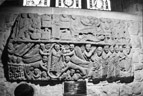
Object type: Coped sarcophagus cover
Measurements: H. 80 cm (31.5 in); W. 158 > 141 cm (62.25 > 55.5 in); D. 13 cm (5.1 in) at apex of cope
Stone type: Medium brown (5YR 4/4), poorly sorted, clast-supported, medium- to coarse-grained sandstone. The clasts, varying from sub-angular to sub-rounded, vary from 0.3 to 0.7 mm, but most are in the range 0.4–0.6 mm. Hollington Formation, Sherwood Sandstone Group, Triassic (C.R.B.)
Plate numbers in printed volume: Ills. 446–55; Fig. 47
Corpus volume reference: Vol 13 p. 240-250
(There may be more views or larger images available for this item. Click on the thumbnail image to view.)
A (broad): The decoration is arranged in two registers of high-relief figural ornament divided by a narrow roll moulding that runs horizontally across the stone at the apex of the cope. The figures are organised so that, although there is no clear framework dividing them, in most cases stylistic devices, such as the side of a figure, or the relative positions between them, separate the figures into eight discrete scenes (Fig. 47). The remains of a vertical roll moulding survive on the lower right of the stone.
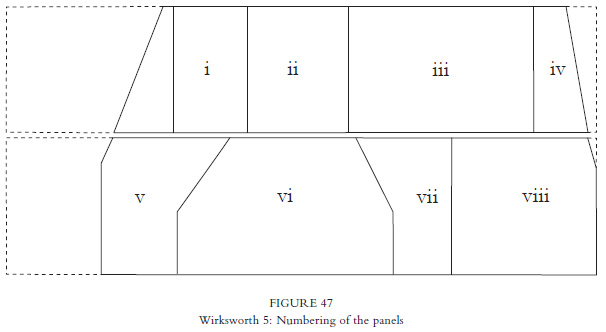
Upper Register: At the far left is the hand of a figure, otherwise lost in the break in the stone, holding a long staff. Next to this is a group of figures comprising the first extant scene (i) (Ill. 447). This consists of three forwards-facing figures with a fourth bent over in front of them. Although slightly worn, all have short hair (identifying them as male), well-modelled faces and deeply drilled eyes. All wear plain, but heavily pleated, full-length garments. The figure on the left draws his robe across his body, with both hands visible across his chest and swathed in heavy folds falling across his arms; his lower body is hidden from view behind the bent figure. The second figure, set slightly behind the first, also holds his hands over his chest; the hem of his robe and his feet are visible behind the bending figure. The head of the third figure, on the right, has been damaged, but his heavily pleated robes are clear, drawn across his body; his bare legs are visible below the hem and his feet are placed in a large round basin. The fourth figure bends over this, with both hands grasping the right foot in the basin. His body is in profile, but his face is turned towards the viewer. A piece of cloth, articulated as a series of five ribbed mouldings, is wrapped round his waist. The next group (scene ii) (Ill. 448) features a large plain equal-armed Greek cross with a quadruped at its centre. The body, in profile, faces right, with the legs curled underneath; its head, with deeply drilled eyes, is turned to face the viewer. Four half-length figures bearing large square books and wearing heavily pleated robes fill the spandrels of the cross. The books are held so that they flank the upper and lower arms of the cross. The figures in the upper spandrels are considerably worn, such that the head of that on the upper left cannot be deciphered, but that in the upper right has a human head with short hair, faces forwards, and points to the book with his left hand. The figure on the lower left has a bird’s head turned to the right to face the lower arm of the cross; the book appears to be held in the veiled, left hand. The figure on the lower right holds the book in a veiled (right) hand and points to it with the left. The head of this figure, which is turned to the left to face the cross, has ears and a long snout. The next group (scene iii) (Ill. 449) involves a number of figures, two of whom, full-length, stand three-quarter turned to gaze out at the viewer. Between them they carry a stretcher with a full-length swathed figure lying on a plain semi-circular element; its veiled head, which looks out at the viewer, lies to the right. Above is a sub-circular frame containing seven heads. Lying below the recumbent figure is a fourth figure with short hair, his head slightly raised and looking out at the spectator; his legs are sharply bent and his hands are raised to clasp the bar of the stretcher above. To the right of this procession a fifth full-length figure stands holding a long-stemmed frond in both hands; a heavy swathe of drapery hangs over his extended right arm. Next to this figure, and half-hidden behind him, is one of the pair of standing figures that forms the final group (scene iv) (Ill. 450) of the upper register. He faces forwards holding a diminutive swathed figure diagonally across his body in such a way that the head lies by his right shoulder. Reaching over towards this small figure is the hand of the second full-length figure whose partial remains consist of the right foot and right side of the body clothed in a full-length robe. Three horizontal parallel ribbed mouldings that taper at the end in a V-shape are visible above the extended arm of this figure.
Lower Register: The scene on the far left (v) (Ill. 452) consists of two groups of figures, one set above the other. The lowermost consists of three heads with the characteristic short hair, well-modelled faces and deeply drilled eyes emerging from a square object contained along its upper edge by a horizontal roll moulding and decorated with three vertical mouldings from which emerge a series of curved elements. Above, on the right, lies a diagonally placed rectangular box containing a heavily swathed figure with short hair. Reaching over towards the box to grasp its open lid is the right hand of another figure, whose head (facing the viewer) and arm are all that survive beyond the break in the stone to the left. The extended group of figures that lies to the right (scene vi) (Ill. 453) centres on a three-quarter turned full-length figure surrounded by an oval frame that rests on a short, slightly curved horizontal moulding. He grasps the stem of a staff-cross held diagonally across his body and over his left shoulder with both hands; the cross-head protrudes over the roll moulding of the oval frame. Flanking this are four angels, two on each side, characterised by long wings composed of regular parallel ribbed mouldings that taper and flip up at the end. The upper two emerge, half-length, above the bodies of those below; they grasp the oval frame with both hands and turn to face the viewer. The angels below also face the spectator while their full-length bodies are seen in profile. They place one hand over the oval frame while grasping it between the thumb and fingers of the other. Below, and flanking the oval frame, are two further pairs of figures each consisting of an angel and a veiled figure. The angels face outwards, and hold one arm across their body to gesture towards the central, cross-bearing figure, while the other arm, holding a scroll, crosses the body in the opposite direction. The wing of the angel on the left, partially obscured by the feet of the angel above, is ribbed; that of the angel on the left has been carved in outline, but lacks the characteristic ribbing. The heads of both the veiled (female), figures are three-quarter turned towards the centre. The pair of figures to the right of this extensive group (scene vii) (Ill. 454) consists of a half-length angel and a seated figure. The angel sports the characteristically ribbed wings; his right arm crosses his body to gesture towards the seated figure while his other arm, holding a scroll, crosses his body in the opposite direction. The head of the seated figure, turned to face the viewer, is framed on the right by a thin vertical feature suggesting a veil. With one hand she holds the heavy folds of her full-length robe across her body in a swirling circular pattern; the other is extended towards the angel. She is seated in a chair defined by a series of parallel mouldings that curve up on the right. The last group (scene viii) (Ill. 455) consists of three full-length figures standing, three-quarter turned to the right. That on the far left, having short hair, holds his robes across his body with one hand and extends the other over the shoulder of the figure next to him. This figure, who is veiled, holds her robes in a similar fashion and extends her other hand towards the shoulder of the figure next to her on the right. This third figure, also veiled, holds out a diminutive, short-haired figure clasping a large scroll, towards a fifth (full-length) figure who has short hair and is three-quarter turned towards them; he extends one arm towards the diminutive figure. The lower part of his body is hidden behind a plain rectangular feature that extends under the feet of the diminutive figure and curves sharply up at the right.
B (narrow): Partly broken, but where the original surface survives, dressed and plain, confirming the coped form of the piece and the horizontal register of A (Ill. 451).
C (broad): Inaccessible
D (narrow): Broken
The remains of the vertical roll moulding on the lower right implies that, despite the break in the upper corner, the stone did not extend further on the right. The remains of the figure holding a staff on the upper left, and the apparent truncation of the figure immediately below (in scene v), further suggest that the stone is incomplete on the left. It would have extended to include the complete versions of scenes i and v, and may even have extended beyond this to include two further scenes in each register. Overall, it has been estimated that approximately 42 cm (16.5 in) has been lost on the left, making it originally about 2 m (78.75 in) long (Cockerton 1961, 230–1; id. 1962; Hawkes 1989, 435–6; id. 1995b, 246–89). This implies that scenes ii and vi would originally have been central to the arrangement, being flanked by two scenes on each side. The estimated dimensions (and coped form of the stone), also indicate that it originally functioned as a grave cover, most likely covering a sarcophagus which, because of the unworn condition of the carving, probably stood within the church (Radford 1961a, 209; Hawkes 1995b, 273). The arrangement of the decoration in two horizontal registers further implies that the monument was intended to be viewed from one long side, while the greater wear sustained along the horizontal edge of the upper register has been taken to imply the monument was set against a wall where subsequent damp eroded the carving at this point (Kurth 1945, 114–15).
The identity of the carved scenes preserved on the stone have been the subject of considerable discussion, but the good quality of the carving means that most differences of opinion have arisen from assumptions concerning the models lying behind the images (Coatsworth 1979, 50; Harbison 1987), and the iconographic controls underlying the choice of scenes–assumptions which have also led to attempts to identify the scene lost from the upper left of the stone (Kurth 1945; Cockerton 1961; 1962; Rollason et al. 1996, 39).
Based on observations of the extant carving, the details of scene i (Ill. 447) are sufficiently distinctive to identify it as illustrating Christ Washing the Disciples’ Feet (Rawlins 1821, 402; Routh 1937a, 41; id. 1937b, 45; Kurth 1945, 117; Cockerton 1961, 230; id. 1962, 8–9; Bailey 1990, 12; Hawkes 1989, 460–4; id. 1995a, 247–9; Rollason et al. 1996, 39). They also serve to identify the nature of the models lying behind the scene. The way Christ bends deeply over the basin to wash the disciple’s feet with both hands, the way this disciple has both feet in the basin, and the presence of two witnessing apostles, are all details that distinguish the scene as emerging from an iconographic tradition featured in the early Christian art of the eastern Mediterranean, such as the late sixth-century Augustine Gospels (Cambridge, Corpus Christi College MS 286, fol.125v: see Ill. 656) and the contemporary Rossano Gospel Book (Rossano, Calabria, Museo del Arcievescovado MS 50, fol. 3r). The close relationship between scene i and such examples, and the differences it has with later western works (even those adapted from such sources), suggest that it was not too far removed from its original (eastern) prototype.
The motives informing the selection of this scene are less clear. The episode had a complex set of references, not least because the biblical account itself (John 1: 1–20, 34–5), commemorates Christ’s commandment to mutual love while also apparently alluding to the rituals of Baptism and the Eucharist. As an expression of Christ’s commandment the rite of foot-washing was firmly established in Anglo-Saxon England (e.g. V.Cuthb. VII: Colgrave 1940, 177), and although it was never accepted as part of the liturgy of Baptism by the papal Church, it was practiced in this context in the Insular world (Warren 1881, 217; Wilmart 1923; id. 1947; Kantorowicz 1956, 208–19; Klauser 1979, 81–3; Hawkes 1995b, 263), where it could also form part of the eucharistic rites (Klauser 1979, 77–8). The reproduction of the scene on Wirksworth 5, therefore, could well have had a liturgical significance, but it could equally have expressed the example of love and humility given by Christ at the Last Supper.
Scene ii (Ill. 448) is usually identified as a symbolic Crucifixion. This explanation is based on an interpretation of the central quadruped as the Agnus Dei, the symbol of Christ’s Passion, and the four beasts surrounding the cross as evangelist symbols (Rawlins 1821, 402; Routh 1937a, 41; id. 1937b, 45; Kurth 1945, 117–18; Cockerton 1961, 230; id. 1962, 9; Thomas 1971, 158; Coatsworth 1979, 58; Hawkes 1989, 465–78; Rollason et al. 1996, 39–40; Hawkes 1995b, 249–52). While the identity of these creatures is not problematic, the explanation of them as together comprising a symbolic Crucifixion is debateable. There are very few early medieval examples of the Lamb on the cross designed to illustrate the Crucifixion, and those that do (e.g. ciborium column, San Marco, Venice), include other figures, such as the spear- and sponge-bearers, or Mary and John, who serve to identify the scene clearly as a Crucifixion. Furthermore, it is not clear that the Wirksworth Lamb should be viewed specifically as the Agnus Dei, a motif that was used to symbolise Christ’s death in Christian art only from the ninth century onwards. Before this it was the Agnus Victor or Maiestas Agni that were used: the Lamb that denoted Christ in his capacity as eternal victor and heavenly ruler. While the Lamb belongs to an area of symbolism where the imagery of Crucifixion and Apocalypse overlap (Raw 1967, 391), the iconographic context of each image generally served to identify the specific frame of reference. Thus, the Lamb accompanied by symbols of the Passion and the Eucharist (e.g. ninth-century Alcuin Bible: Bamberg, Staatliche Bibl. MA 1, fol. 339v), can be identified as the Agnus Dei, but when accompanied by symbols of the Second Coming, as in the ninth-century Codex Aureus from St Emmeran (Munich, Bayerische Staatsbibl. Cod. Lat. 1400, fol. 67v), it can be identified as the apocalyptic Agnus Victor. In these contexts, the Lamb tends to be crouched and enthroned before a cross and flanked by the evangelist symbols (e.g. sixth-century mosaics of SS Cosmas and Damian, Rome: see Ill. 657). It is only in the closely related scheme of the Majestas Agni, which flourished briefly in Merovingian art of the later eighth century, that the Lamb is set directly on the cross and associated with the evangelist symbols and other motifs referring to the Apocalypse (e.g. the Laon Orosius and Gelasium Sacramentary: Laon, Bibl. Nat. MS 137, fol. 1v; Vatican, Bibl. Apost. Reg. Lat. 316, fols. 3v, 132). In these instances, however, the Lamb stands on the cross. Moreover, the unusual zoo-anthropomorphic form of the evangelist symbols, pointing to books held in veiled hands, is a combination of features found only in Anglo-Saxon art of the early eighth century (e.g. the Maaseik Gospel Book: Maaseik, Church of St Catherine, Trésor s.n., fols. 6–11v). In Merovingian art the zoo-anthropomorphic symbols do not carry books (e.g. the Laon Orosius and the Gospel of St Croix at Poitiers: Bibl. Mun. MS 17, fol. 31). Taken together, therefore, the evidence suggests the Wirksworth scene presents a composite of details that were circulating in western Europe between the sixth and eighth centuries that were brought together, briefly, in eighth-century Anglo-Saxon art and reflected in Merovingian art.
Like any image of the Lamb of the Apocalypse the Wirksworth scheme would have been understood to include references to the sacrificial, but victorious death of Christ on the cross. These notions of apotheosis and sacrifice are woven into the biblical texts (Exodus 12–13; Isaiah 53; Jeremiah 11; Matthew 26: 17; Mark 14: 12; Luke 22: 1; John 1: 29; I Corinthians 5: 7–8; Revelation 5), and are often reflected in the liturgical practices of the early Church. As Ó Carragáin (1978; 1986) has demonstrated, the sacrificial and paschal aspects of the Lamb were evoked in the liturgy of the early Anglo-Saxon Church at the Veneration of the Cross on Good Friday and in the celebrations of Baptism and the Eucharist. Nevertheless, extended though such treatments were, the Lamb had a recognised eschatological relevance that, in the liturgy, associated the Eucharist with the Apocalypse (Warren 1906, 13): to be unworthy of the Eucharist was to incur the judgement of damnation. Elsewhere, the Lamb of the Apocalypse was also associated with the Church founded on Christ. Bede’s commentary on Revelation (Gryson 2001; Wallis 2013), for instance, emphasised the adoration and glory due the Church through the Lamb. Overall, therefore, scene ii at Wirksworth can be understood to symbolise triumph and glory; the risen Lamb enthroned on a cross functions as a sign of the victory of Christ’s death. This does not mean that notions of sacrifice associated with the Crucifixion and the Agnus Dei, witnessed in the Gospels and embodied in the liturgy of the Church are not present, only that the use of the Maiestas Agni, as opposed to the Agnus Dei, indicates that it is the exaltation and glory due Christ and his Church, both in the present and at the Second Coming, which were intended to be primary.
It is generally accepted that the figures of scene iii (Ill. 449) depict the Funeral Procession of the Virgin (Routh 1937a, 41–2; id. 1937b, 45; Kurth 1945, 118; Cockerton 1961, 230; id. 1962, 9–10; Bailey 1990, 12–13; Hawkes 1989, 478–81; Rollason et al. 1996, 40; Hawkes 1995b, 252–3). This is an episode recounted most fully in the apocryphal narrative of the Pseudo-Melito (James 1924, 209–13), and identifies the body on the stretcher as the Virgin, with John carrying a palm leaf. Above, in the oval of glory, is the choir of angels and below, the body of the chief priest is dragged along with his hands attached to the bier, prior to the miracle of healing and salvation performed by Peter. The scene conforms so closely to the written description of the event that its identity seems undeniable. However, other examples of this scene have not survived in Christian art of the early medieval period; rather, the events surrounding Mary’s death were depicted by the Dormition and Assumption. Despite this lack of extant earlier visual evidence, however, accounts of the holy sites of Palestine from the sixth century onwards record specific iconographic schemes promoting the sites (Weitzmann 1974; Vikan 1982), and Willibald’s eighth-century account of Jerusalem describes a series of monuments associated with the events surrounding the death of the Virgin: one commemorated her Dormition, another her tomb, and a third was raised at the point that marked the interruption of the funeral procession (MGH: SS 15.i, 97–8). By the ninth century these events were included in fresco cycles depicting the life and death of the Virgin (e.g. Santa Maria Egyziaca, Rome: Lafontaine 1959, 29–35; cf. Clayton 1990, 50–157; 1998, 107, 109). Scene iii can probably, therefore, be accepted as having been based on an image type developed as part of the process of promoting the cult of the Virgin, initially in the eastern Mediterranean.
Despite the clarity of the procession, the nature of the figures to the right (scene iv, Ill. 450) has occasioned considerable debate. Kurth (1945, 117) identified them as illustrating the ‘sword-type’ of Massacre of the Innocents. However, the few examples of this iconographic scheme that have survived from before the twelfth century do not resemble the Wirksworth scheme (see Bakewell 11). Cockerton, therefore, following Rawlins, identified them as forming the Presentation of Christ in the Temple, with Simeon on the left holding Christ, Mary on the right having just placed him in the priest’s arm, and the Hand of God between them (Rawlins 1821, 401; Cockerton 1961, 230–1; id. 1962, 10–11; c.f. Bailey 1990, 10; Rollason et al. 1996, 40). This explanation, however, is problematic. Across Wirksworth 5 the male figures are shown with a short fringe of hair and wear garments that are slightly shorter than those worn by the female figures, who are veiled, and whose feet only just protrude from the hems of their longer robes. Of the two figures, that on the left is clearly male (he has the fringe of short hair and wears the shorter length robe), and, while the head of the second figure is missing, the robe is of the same (shorter) length, suggesting it too was male; this implies that the scene was composed of two standing male figures. And, rather than depicting the Manus Dei (which normally features four or five fingers), the three parallel mouldings arranged in the distinctive V-shape lying between the figures are best understood as the wing-tip of an angel (the figure standing on the right)—like those featured in scenes vi and vii below. Furthermore, the way the standing figures are not clearly separated from those of the Funeral Procession indicates they are probably related to that episode. The sleeve of John and the palm he holds both pass in front of the male figure carrying the infant, just as the arm of the angel does on the other side. In fact, John and the angel appear to flank this figure, their feet turning towards him, while he, in contrast, stands facing forwards. As an extension of the Funeral Procession, a male figure with an infant and an angel can be explained as Christ handing the Virgin’s soul, usually represented in Christian art as a swaddled child, to the angel (Hawkes 1995a, 253–5).
Like the Foot Washing and Apocalypse, the events surrounding the death of the Virgin were familiar in Anglo-Saxon England by the eighth century although their liturgical commemoration was less secure, a situation undoubtedly reflecting the long-standing theological debate surrounding the corporeal assumption of the Virgin (Clayton 1984, 211–14; id. 1990, 27–42; id. 1998, 104–7, 109; Lapidge and Rosier 1985, 49; Campbell 1967, 37). It is an uncertainty reflected in Insular texts: Adomnán of Iona, recounting the travels of Arculf in Palestine (c. 670), seems to have been ignorant of the assumption and assumes the Virgin’s body was awaiting resurrection (Greyer 1898, 240); Willibald, on the other hand (c. 725), knew the legends of the death, funeral procession and assumption of the Virgin, but although he describes the incident of the funeral in great deal, he is notably reticent in accepting the notion of her corporeal assumption (MGH: SS 15.i, 98). Despite such equivocations there was a readiness to recognise the event as an episode emphasising the Virgin’s exemplary virtues. Bede is credited with two homilies that refer to her death: one, designed to be read on the day of the Assumption, uses the occasion to reaffirm the contemplative life of the religious, exemplified by Mary, the sister of Lazarus; the other sets out the honour and glory rightfully due Mary for her obedience, humility and chastity (Homilia LVII: ‘In die Assumptionis Mariæ; Homilia LIX: De Sancta Maria Virgine, PL 94, 420–1, 422-3). The lessons drawn from the death of the Virgin, therefore, were consistent: Mary was an exemplary figure of the monastic virtues who was duly rewarded in death. Given this, it is perhaps significant that the scene on Wirksworth 5 does not depict either the Dormition or the Assumption, the two events associated with specific theological and liturgical concerns. It would have been possible to reproduce either scene: the iconography of the Assumption closely replicates that of the Ascension, while that of the Dormition is not too far removed from the Funeral depicted at Wirksworth. If, however, the intention was to avoid doctrinally contentious events, the Funeral is suitably neutral: it recalls both Dormition and Assumption as well as the miracle performed during the procession. It thus expresses general themes of the glory and reward awaiting the humble and obedient Christian in death, while recalling the virtues of obedience and chastity associated with Mary and celebrated on any feast day held in her honour.
There has been considerable discussion over the identity of scene v (Ill. 452). Attempts to explain it as part of a Nativity scene have involved identifying the short-haired figures in the group with female protagonists (Marucchi 1924, 154; Kurth 1945, 117; Harbison 1987, 36–8; Rollason et al. 1996, 41); other attempts, to identify it as depicting the Three Hebrew Children, have ignored the upper figures in the scene (Routh 1937a, 41; 1937b, 45). Cockerton, however, followed by Hawkes, suggested that, together, the figures depict the Anastasis, Christ’s Descent into, or Harrowing of Hell (Cockerton 1961, 231; id. 1962, 11–12; Hawkes 1989, 488–94; id. 1995b, 255–6). Within the iconographic traditions associated with this event, the upper group of figures can be identified as Christ, the second Adam, leaning over to symbolically deliver humanity, in the form of the first Adam, the living soul, from the bonds of Hell; the lower three figures can be identified as the three souls left in Hell after Christ’s Resurrection (Cain, Herod and Judas), described in the fifth-century apocryphal Book of the Resurrection of Christ by Bartholomew the Apostle (James 1924, 181–6). While such a specific identification of the lower figures may be speculative, the overall interpretation holds some credibility as the earliest iconographic versions of the Descent contain most of the elements featured at Wirksworth: namely, two or three half-length figures (symbolic of the general resurrection of the dead) emerging from a coffin, and Christ leaning over towards Adam to release him from another coffin.
Although not a scriptural event, Christ was understood to have foretold his Descent when speaking of Jonah in the belly of the whale (Matthew 12: 40), and the full story, narrated in the apocryphal Gospel of Bartholomew and the Acts of Pilate (James 1924, 181–6, 117–18), was known in the Insular world. It was also commemorated daily in Anglo-Saxon England, being remembered at Matins and recited in the Creed, probably as early as the seventh century (Plummer 1896, 408–9; Ure 1957, 88); and it was articulated in the rituals of Baptism where the rite itself was regarded as a re-enactment of Christ’s descent into death, his resurrection and ascension. In more general exegetical traditions the Descent was viewed as demonstrating Christ’s obedient humility and the salvation it offered of future resurrection. In Anglo-Saxon England, therefore, the Descent was familiar in everyday worship and in the rituals of Baptism (Ó Carragáin 1978; Klauser 1979, 77–9), while in Old English literature it was invoked to recall Christ’s glory through proving the possibility of resurrection. Thus, scene v can be understood as probably illustrating Christ descending to Hell in full humility to release Adam and his kin from bondage: as the resurrected were led to heaven by Christ, so too would the faithful Christian be rewarded with eternal life at the Final Resurrection, a process commemorated in the daily liturgy of the Church.
The next scene (vi, Ill. 453), originally the central scene of the lower register, has been universally identified as the Ascension of Christ (Rawlins 1821, 403; Routh 1937a, 41; id. 1937b, 45; Kurth 1945, 118; Cockerton 1961, 230–1; id. 1962, 12–13; Raw 1967, 392; Bailey 1990, 12; Hawkes 1989, 494–504; Rollason et al. 1996, 41–2; Hawkes 1995b, 257–9). Composed of Christ standing in a central mandorla flanked by angels, with witnessing figures flanked by two further angels below, the scheme has much in common with the iconography of the Ascension developed in early eastern art. The way Christ stands facing forwards grasping a staff-cross (symbolic of the Resurrection), and the way the angels grasp the mandorla surrounding him, further confirm the eastern origin of the source lying behind the scheme, and suggest an early date for the prototype. The only real difference between such scenes and the Wirksworth image lies in the lower pair of figures: there are no parallels for only two witnesses, nor for those being women. Normally, the Ascension is witnessed by the Virgin flanked on either side by twelve apostles, while the angels accompanying them, if present, stand, full-length, on either side; they are not depicted as half-length figures bearing scrolls. Scene vii, next to the Ascension, however, does include just such an angel addressing the Virgin at the Annunciation. As the lower pair of angels at the Ascension share the role of messenger with the angel of the Annunciation, it is likely that the attribute and pose associated with that function in the Annunciation were appropriated for the lowermost angels in the Ascension–either because of the absence of angels from the model lying behind the scene, or more likely, because the scene had to be adapted to the limited confines of the register. This is also the most likely explanation for the reduction of the usual crowd of witnessing figures to two. What is more difficult to explain is the identity of these two witnesses. The condition of the carving is especially good at this point, and both clearly wear the veils distinguishing female figures on Wirksworth 5. The presence of one such figure, the Virgin, can of course, be explained as the result of reducing the usual crowd of witnesses; in this case, the second figure might be expected to be male, representing the apostles. The inclusion of a second female figure, therefore, can only be plausibly explained as, either a deliberately intended portrait of a female patron associated with the Wirksworth community, or as an inconsistency. The first alternative cannot be substantiated without further information concerning the historical context of the monument; the second is possible as the wings of the angel on the right have not been completed, and the Virgin of the Annunciation appears to have two left hands. Whatever the explanation for the presence of the second witnessing woman, the scene clearly depicts the Annunciation of Christ, and is iconographically related to images of early eastern origin. As a result of the scene being adapted to fit the confines of the register, it focuses on the figure of Christ ascending with the cross of the Resurrection.
The biblical account of the Ascension (in Acts 1: 1–11), ensured that it commemorated the last words of Christ to his apostles (to bear witness to him), and demonstrated the divine power of the risen Christ who would return in glory as Judge (Hawkes 1996, 81–4). These themes were invoked at the Feast of the Ascension, celebrated in Anglo-Saxon England by the seventh century, and Bede’s homilies and prayers for the occasion describe the event as the glorious and final proof of Christ’s divinity and therefore of his salvation (Homilia II.15: In Ascensione Domini; Hymnus VI: In Ascensione Domini: Hurst and Fraipont 1955, 280–9; 419–23). This aspect of the event is clearly signified at Wirksworth with its emphasis on the risen Christ within the mandorla of glory, holding the cross of the Resurrection, and surrounded by angels, the traditional attendants on the heavenly throne.
As noted, scene vii (Ill. 454) is widely accepted as depicting the Annunciation to the Virgin, with the angel emerging from behind the wings of the ascending angels to address Mary, who, seated in a wicker chair on the right, extends one hand towards him while gathering her robes round her with the other (Routh 1937a, 41; id. 1937b, 45-6; Kurth 1945, 117; Cockerton 1961, 230–1; id. 1962, 13–14; Bailey 1990, 12; Hawkes 1989, 504–8; Rollason et al. 1996, 42; Hawkes 1995b, 259–60). The distinctive details of the scene not only serve to identify it, they also indicate its dependence on versions of the scene that appeared in early eastern art of the sixth century. The crossed-arm pose of the angel, for instance, although found in other Anglo-Saxon versions of the event (such as the eighth-century Genoels-Elderen Diptych), is an eccentric feature associated primarily with eastern versions of the scene. The wicker chair in which Mary sits demonstrates a similar provenance, as may her half-turned stance, which is not a common feature in early medieval art, but does occur in early eastern scenes–in instances where Mary is seated in the wicker chair holding her robes across her body with one hand–to signify the virginal shock with which Mary is reputed to have reacted to the angel’s appearance. Together, the details of scene vii demonstrate dependence on a model closely related to depictions of the Annunciation that flourished in the East during the sixth century.
Described only in Luke (1: 26–38) the episode had a long history in the literature of the early Church, although its place in the calendar took longer to establish due to the coincidence of its date (March 25) with Lent and the fact that it was not always viewed as strictly Marian (Klauser 1979, 90; Clayton 1984, 210–13; id. 1990, 26–41). Although Bede’s works indicate that the feast was known in Anglo-Saxon England by the early eighth century, other sources suggest it was not firmly established until the second half of that century (Campbell 1967, 37; Clayton 1990, 38–41). Nevertheless, Anglo-Saxon ecclesiasts consistently regarded the event to be part of God’s plan to save humanity, as well as exemplifying Mary’s humble obedience, a virtue worthy of praise and honour. At Wirksworth the Virgin is clearly shown receiving the angel’s message and submitted herself to God’s will, with one hand upraised, while her half-turned position and the way she draws her robes around her, express her virginal purity at the conception.
The identity of scene viii (ill. 455), consisting of a man and two women facing another man on the right, with a diminutive male figure holding a scroll being passed between them, has excited considerable debate. Most interpretations, however, have involved identifying the female figures with male protagonists (Rawlins 1821, 401; Routh 1937, 41–2; id. 1937b, 46; Harbison 1987, 38–40; Rollason et al. 1996, 42–3), or have suggested scenes otherwise unattested in Christian art of any period (Marucchi 1924, 157–8; Cockerton 1961, 231; id. 1962, 14–15). Rejecting these, therefore, Hawkes (1989, 508–14; 1995b, 260–1), following Kurth (1945, 117), identified the scene as illustrating the Presentation of Christ, one of the only episodes in Christian art consisting of male, female and infant figures disposed as at Wirksworth. Depictions of the Presentation did vary in early Christian art, largely because of the ambiguity concerning its place in the liturgical calendar, but one version, which seems to be portrayed at Wirksworth, was distinguished by the absence of an altar. Known as the Hypapante, it illustrated the meeting of Simeon with the Holy Family, witnessed by Anna outside the temple (rather than the ceremony of the presentation of the first-born inside the temple where the altar is included). Depictions of the Hypapante vary the disposition of the figures around Christ, but Simeon is generally isolated from the others, and Christ tends to be portrayed as a diminutive adult (e.g. the eleventh-century Farfa Casket, produced in southern Italy from an eastern prototype pre-dating the eighth century: see Bergman 1980, fig. 152). Furthermore, although the gestures of the protagonists varied, those witnesses not holding sacrificial doves generally hold their hands half-raised in acclamation. Moreover, the rectangular object before Simeon that curves up on the right, never present in scenes of the Presentation where the Child is passed over the altar to the priest, features in the Farfa Casket version of the Hypapante, where it functions as a low wall that tapers upwards on the right in front of Simeon, and continues in front of Mary and Joseph on the left, leaving a space under the figure of Christ. At Wirksworth it seems that the wall on the left was omitted, but retained on the right, suggesting, along with the grouping of the figures and their distinctive details, that the scene can be identified as the Hypapante, a version of the Presentation, and was based on a model derived from an early eastern prototype.
Luke’s account of Christ’s Presentation (2: 22–39), combines two distinct ceremonies: the presentation of the first-born male at the Temple, which occurred thirty days after birth, and the purification of the mother, which occurred forty days after childbirth (Exodus 13: 12–15; Numbers 18: 15–16; Leviticus 12: 2–8). As a result, the liturgical standing of the event was subject to considerable fluctuation: between the Marian Purification and the Christological Hypapante and Presentation (Shorr 1946, 17–19; Clayton 1984, 209–10; id. 1990, 36–41). This delayed the establishment of the feast in Anglo-Saxon England, as elsewhere in western Europe. Although Bede describes the candlelight procession of the Purification early in the eighth century, the feast (in any form), does not seem to have been established with any regularity in the region before the later eighth century. In the exegetical literature, there is a similar division of emphasis. Most commonly the event was interpreted as revealing the exemplary chastity of Mary (the supreme example of virginity) and Anna (an example of widowed chastity), but almost as popular, was the interpretation of Simeon and Anna’s words in the temple as pointing to God’s future salvation through Christ. Concomitant with these was the understanding of Simeon’s words following his recital of the Nunc Dimitis, as foretelling the sorrow and tribulation to be suffered by Mary as a result of Christ’s salvific sacrifice. While the iconography of the Wirksworth scene is based on an earlier image of the Hypapante, this does not mean that it signifies the existence of the feast in the region. What it does illustrate is the meeting between Simeon and Christ which was intended to recall the prophecy made by Simeon; it thus refers to the future passion of Christ and the implications of that event on Mary, and by extension, humanity.
Overall, therefore, the models lying behind the extant scenes on Wirksworth 5 seem to have their origin in eastern art, particularly that of the Syro-Palestinian provinces in the sixth century. Where present in western centres, these types were never subsumed into the more popular western repertoire. Only the image of the Maiestas Agni does not betray this influence, its closest parallels lying with eighth-century Anglo-Saxon and Merovingian art. The figural style employed across the piece also points to ultimately early eastern sources of influence. It is characterised by oval-shaped heads with broad foreheads and full rounded cheeks, well-modelled eyes, and the short fringe of hair across the forehead. The hands and feet are not well formed but their positioning is not random, while the clothing, coherently rendered, tends towards repeated patterns of regular ribbed pleats and, although there is little suggestion of a body within, the tubular aspect of the clothing presents a three-dimensional quality. These are all features of carved figural art found in eastern works of the fourth to sixth centuries that was adopted in certain western centres in northern Italy and Gaul where it survived into the seventh century.
Thus, the distinctive figural style of Wirksworth 5, along with the iconographic details of the scenes, together suggest the strong influence of artistic models that had their origins in the East. Given the availability of such models, these could have been reproduced at Wirksworth any time after the sixth century, but the short-lived iconography of the Maiestas Agni implies that the monument is unlikely to have been produced before the eighth century or after the early ninth century. In addition, the lack of iconographic developments associated with Carolingian art of the later eighth and ninth centuries, suggests the carving pre-dates the general impact of such innovations in Anglo-Saxon England during the ninth century. The figural carving of other Anglo-Saxon works, even when based on archaic model types, tends to reveal attempts to adapt those types in keeping with recent developments (Hawkes 1993; 1996; 2002a). The absence of such manipulations at Wirksworth, and the dates of the models informing the scenes, suggest the monument is best dated to the later eighth century.
Clearly, the symbolic significances of the carvings offer a complex set of potential references. While allusions to Christ's redemption of humanity, and so to the Resurrection, is common to all the scenes, however, the theme of redemption is so central to Christianity that almost any image in early Christian art could reference it in some way. Many of the scenes refer more specifically to the rituals of Baptism and the Eucharist (scenes i-ii, v-vi, and viii), but these references are not invoked systematically. There are, likewise, no clear references to events commemorated in the liturgical calendar in Anglo-Saxon England during the seventh and eighth centuries, which were, in any case far from uniformly established. There is nevertheless, one theme that is consistently referenced: namely, humility and obedience rewarded in death with life everlasting, as exemplified by Christ and his mother. Christ is shown humbling himself in life by washing the disciple's feet, an act that bears with it the concomitant commandment to mutual love. In death, he again humbles himself by descending into Hell to release humanity from sin; as one of the last demeaning acts performed by Christ it promised the future resurrection of the dead – which is confirmed by the Ascension of the man, Jesus Christ, who will return as Judge on the Last Day, at which time the Lamb will appear in the heavens in majesty. These notions of loving humility rewarded, exemplified by Christ on the right of Wirksworth 5, are given wider application through the events associated with Mary on the left: her conscious act of obedience at the Annunciation established her as the humble handmaiden of the Lord and as an example of obedient devotion; at the Presentation, this way of life is seen to bring pain and hardship, but the reward for a life of self-abnegation is presented in her death when Mary was taken to heaven and a miracle of salvation performed at her funeral.
Not only is this reading of Wirksworth 5 consistent with the iconography of the surviving scenes, it is also appropriate to its original function as a funerary monument. Thus, the central motifs promise the resurrection of the dead and life everlasting to be confirmed at the Second Coming. The scenes of Christ on one side and Mary on the other demonstrate how this was made possible and provide the necessary exemplars to emulate. As might be expected, these are appropriate both to the person within the sarcophagus and to those viewing it. However, the deliberate presentation of Christ and Mary as separate individuals given almost equal importance as examples for every Christian to follow, may indicate that the person for whom the sarcophagus was designed, evidently a person of some standing, was a female patron or member of the community at Wirksworth (who may have inspired the portrayal of the second woman at the Ascension scene), and that those anticipated to be viewing the monument would have included in their number a significant female presence. It implies that the monument was originally set up either within a female or double monastery. What little is known of the church at Wirksworth is not at odds with such suggestions: it appears to have been a dependency of the royal foundation at Repton, fifteen miles to the south, a double monastery ruled by an abbess for which it provided a valuable supply of lead (Cox 1892, 19-21; Biddle and Kjølbye-Biddle 1985, 234-5; Hinton 1990, 84; see further Chapter IV, p. 43). The complex iconography of the stone, with its lessons of humility and virtue rewarded exemplified by Christ and the Virgin, would have been particularly appropriate in such an environment.
