Select a site alphabetically from the choices shown in the box below. Alternatively, browse sculptural examples using the Forward/Back buttons.
Chapters for this volume, along with copies of original in-text images, are available here.


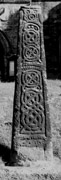
Object type: Incomplete cross-shaft
Measurements: H. 159 cm (62.6 in); W. 40 > 22 cm (15.75 > 8.66 in); D. 28 > 19cm (11 > 7.5 in)
Stone type: Greyish orange pink (5YR 7/2), well sorted, clast-supported, medium-grained, feldspathic quartz sandstone. The sub-angular to sub-rounded clasts of clear quartz vary from 0.3 to 0.4 mm. Bedding parallel to the broad face of the shaft. Millstone Grit Group, Carboniferous (C.R.B.)
Plate numbers in printed volume: Ills. 418–21
Corpus volume reference: Vol 13 p. 231-233
(There may be more views or larger images available for this item. Click on the thumbnail image to view.)
The shaft is highly decorated with a number of motifs, most of which are interlace variants ranging from two to six strands. Each face is edged by worn rounded mouldings which continue the full length of the stone containing the decoration which is further arranged in panels.
A (broad): On this face the decoration is arranged in three complete panels of interlace with additional elements above. The lowermost panel contains a horizontal thin two-strand plait, below which is a plain, but dressed area contained at the bottom by a flat horizontal moulding contiguous with the vertical edge mouldings; the panel is bounded above by a similarly flat horizontal moulding. Above this is a panel contains a series of three encircled patterns, the lower two being linked together as a six-stranded design (closed circuit pattern F: Cramp 1991, fig. 24), and the lowermost terminating as a paired joining. The vertical quadrant spaces formed by the crossing strands of the middle encircled pattern are each filled by a pellet. The uppermost pattern differs in that it is composed of two closed rings with two strands from the lower patterns crossing in the middle (closed circuit pattern A). A pellet fills each of the four segments of the crossing and another two sit inside the strands lying between the upper closed-ring pattern and the two below; these appear to pass behind the closed-ring pattern and terminate at the edge moulding above. The panel is contained above by a semi-arcaded double cable moulding.
The uppermost panel is decorated by two closed-ring patterns, similar to the uppermost pattern in the panel below. The lower pattern is a closed ring encircled by a strand of interlace. Two crossed strands pass behind it and a pellet fills each of the four segments of the crossing. The pattern above receives one strand from the encircling interlace below and one from the crossing strands. It is similar to that below except that the spaces between the crossing strands are empty. The two strands from the central crossing extend above to form a closed horizontal loop that encircles three pellets. Above this the edge mouldings branch into two, with one strand extending towards the centre to form a raised field containing a central boss surrounded by a circular moulding and two pellets to the left and right above. Above, this field is bounded by a thin flat moulding, which may have formed the base for a cross-head, but no mortice hole survives in the upper surface.
B (narrow): This face contains three panels of carved decoration. The lowermost panel is filled with an irregular interlace which terminates at the bottom in V-shaped loops in the form of a Stafford Knot. The two strands from the bottom loops extend upwards and entwine as an irregular spiralling interlace which terminates as a double semi-arcaded moulding. The middle panel is articulated as a round-headed panel formed by a continuous flat moulding set within the outer edge mouldings; this contains a simple two-strand plait and the arcading above is formed from five thin strands extending from the edge mouldings. In the centre of the fourth strand is a small circular motif with an incomplete outer ring. The uppermost panel contains three irregular motifs. The lowermost is a closed-circuit triple inverted V-looped triquetra design incorporating a small pellet within a loop and a detached inverted V framing a further pellet within its apex. Above this are two irregular motifs, the lower comprising a closed loop with a strand extending upwards, and the other a closed irregular looped motif. The two upper motifs may be joined together by a snaking strand but this is unclear.
At the top of the flat dressed area at the top of the shaft is the thin flat moulding that continues from A.
C (broad): This face is filled with two panels of interlace; beneath the lower panel the border is plain. The lower panel itself has a four-stranded turned interlace which terminates at the bottom as a closed loop joining two of the strands, the other two extending to touch the bottom of the panel; the upper part terminates in a closed loop. There are four pellets, two on either side of the pattern, and one within the interlace just above its lowest strand crossing. There are a further three pellets between the extended terminal strands at the bottom. At the top the panel is bounded by a single, flat, arcaded moulding. The upper panel is decorated with an irregular motif in the form of a flattened closed-circuit design above which is a simple four-strand interlace which terminates at the bottom with a closed loop and two extended strand ends. The top of the interlace is damaged with part broken away. On the left the edge moulding can be seen to branch inwards but then is truncated.
D (narrow): This face is filled with two panels of interlace and spiral designs. The lower panel contains a badly executed four-strand simple pattern F interlace (Cramp 1991, fig. 23) which terminates at the bottom with a closed ring and two extended strand ends. This occupies approximately two-thirds of the panel, above which are two spirals which are joined together by a single strand. One of the strands from the interlace below appears to pass behind the lower spiral. At the top the panel is bounded by a double arcaded moulding, extending from the edge mouldings. The upper panel is decorated with an irregular four-strand interlace which terminates at the bottom with a closed loop and two extended strand ends, between which are two pellets. The upper end of the interlace terminates in an irregular closed loop with one strand extending into a spiral above, which has a short spur extending in the opposite direction at the top. The panel is bounded at the top by a rounded moulding contiguous with the edge moulding. Above is the base of what appears to be a simple interlace but all except the lowest extremities are missing. The edge mouldings reappear on each side for a short distance but both are separated from the arcade below by an incised line around the arcade.
The area at the base of the shaft is plain, contained by the vertical edge moulding on the right, and the remains of the damaged moulding on the left; it seems to be bounded across the bottom by a horizontal moulding contiguous with the edge mouldings, but the damage sustained to this part of the stone means this is not at all clear.
This is an interesting cross-shaft and to some extent embodies many design elements which are ubiquitous to the region. The use of four- and six-strand interlaces, for instance, is not uncommon, with examples widespread across the region. However, the use of two-strand plaits as a major form of decoration (as on B) is an arrangement largely confined to the Dove and Derwent valleys of the Peak District, being rare in southern Derbyshire. The same is true of the prominent use of spiral motifs, which also tend to cluster around the Peak District (Sidebottom 1994); one example can be seen at Ilam (2), Staffordshire, where a round-shaft has a spiral design as the terminal of a line pattern (Ill. 555). Otherwise, in its use of relatively common design elements, the shaft is not easily paralleled. It is notable that the execution of the decoration is variable throughout the various panels of the shaft, with some being reasonably well crafted whereas others appear to be poorly carved with many geometric irregularities. The use of irregular patterns, such as those on B is, however, generally typical of smaller cross-shafts, for example at Brailsford (1).
