Select a site alphabetically from the choices shown in the box below. Alternatively, browse sculptural examples using the Forward/Back buttons.
Chapters for this volume, along with copies of original in-text images, are available here.


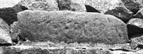
Object type: Part of shaft
Measurements: H. 59 cm (23.2 in); W. 20 cm (7.9 in); D. 10 cm (4 in)
Stone type: Poorly sorted, clast-supported, yellowish grey (5Y 7/2), feldspathic, quartz sandstone; a few grains of mica are present. The sub-angular to sub-rounded clasts vary from 0.2 to 1 mm, the grains are dominantly between 0.4 and 0.8 mm across (medium- to coarse-grained). Millstone Grit Group, Carboniferous (C.R.B.)
Plate numbers in printed volume: Ills. 416–17
Corpus volume reference: Vol 13 p. 231
(There may be more views or larger images available for this item. Click on the thumbnail image to view.)
Only one face of the shaft is visible at present, the other faces being obscured by the stones forming the limestone drystone wall. The shaft is badly worn but a little decoration is discernible. This appears to form a repeated pattern comprising a series of circular or sub-circular motifs running the length of the shaft. These may represent an interlace pattern of an indeterminate number of strands. However, a number of depressions are apparent which suggest that the design may have included a series of triple leaf motifs. No edge mouldings are visible.
The cross-shaft and base are described by the Derbyshire Historic Environment Record as ‘Medieval’ and considered to be post-Conquest, and dimensions suggest that the base is not related to the shaft, at least as far as can be discerned. The shaft, however, may be earlier than the base. What little survives of the decoration, implying the presence of an interlace pattern and foliate motifs, suggests that it can be situated within the Anglo-Saxon period. The pattern, at least for the visible face, appears to be central to the shaft and it may be that the original shaft was not much wider than the surviving fragment.
