Select a site alphabetically from the choices shown in the box below. Alternatively, browse sculptural examples using the Forward/Back buttons.
Chapters for this volume, along with copies of original in-text images, are available here.


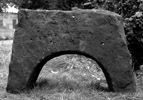
Object type: Lintel
Measurements:
H. 60 cm (23.6 in); W. 88 > 75 cm (34.6 > 29.5 in); D. 30 cm (11.8 in)
Arch H. 32 cm (12.6 in); W. 54 cm (21 in)
Stone type: Greyish orange (10YR 1/4), moderately sorted, clast-supported quartz sandstone. The sub-angular to sub-rounded grains range from 0.2 to 0.5 mm across, but are dominantly in the range 0.3 to 0.4 mm across. Quartz predominates, but there are a few scattered pink feldspars. Helsby Sandstone Formation, Sherwood Sandstone Group, Triassic (C.R.B.)
Plate numbers in printed volume: Ills. 398–400
Corpus volume reference: Vol 13 p. 226
(There may be more views or larger images available for this item. Click on the thumbnail image to view.)
A (broad): The stone is plain and relatively smooth, with some signs of tooling visible. The arch is cut straight through the stone, with no splay, and is undecorated.
B (narrow): Plain and relatively smooth, with some signs of tooling
C (broad): The surface is plain but very uneven and roughly cut.
D (narrow): The surface is plain, and rather uneven.
The finding of two Bunter sandstone lintels (24 and 25) in some part of the Vicarage garden in 1884 might suggest that they had originally been part of the sunken two-celled building, also of Bunter sandstone, found a century later in 1980–6 in Trench 8 in the course of archaeological excavations in the Vicarage garden. That building was demolished to ground level by the Vikings in 873–4 and its sunken eastern cell re-used as the chamber of a burial mound. The upper parts of the building were presumably cast aside, possibly re-used in some way, only to be found elsewhere in the same area and out of their original context a millennium later. If the lintels had once formed part of the two-celled building, the arch of the larger lintel at 54 cm (21 in) wide would have been too narrow to fit over the inner door (width c. 65 cm; 26.6 in) between the eastern and western compartments of the building (Biddle and Kjølbye-Biddle 2001, 71, fig. 4.20, A & B, cf. fig. 4.17). It might however, have formed the head of an eastern or some other window.
