Select a site alphabetically from the choices shown in the box below. Alternatively, browse sculptural examples using the Forward/Back buttons.
Chapters for this volume, along with copies of original in-text images, are available here.


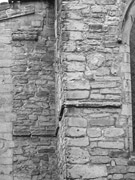
Object type: Exterior of nave/chancel
Measurements: Cannot be accessed
Stone type: Cannot be accessed
Plate numbers in printed volume: Ills. 377–85
Corpus volume reference: Vol 13 p. 224-225
(There may be more views or larger images available for this item. Click on the thumbnail image to view.)
22a. Exterior of nave at 51.30 OD, about mid-height of the east face of the central space, north and south, and continuing round the south-east and north-east angles of the chancel
22b. Exterior of nave, at 55.3 m OD on the east face of the central space, north and south, above the imposts and string courses (22a)
22c. On east face of east wall of chancel, at 57 m OD
22a. Noted by Taylor and Taylor in 1965 (511, fig. 249 moulding profile e, pls. 556–7)
22b. Noted by Taylor and Taylor 1965 (511, fig. 249 moulding profile dd; pls. 556–7)
22c. Noted by Taylor 1971 (375, E 67)
22a. Fragmentary but in good condition
22b. In good condition
22c. In good condition
22a. Imposts and String Courses
Undecorated impost/string courses with a hollow chamfer above a flat rectangular basal strip.
22b. Lower Springers
Undecorated springers composed (according to Taylor and Taylor 1965, fig. 249 dd) of two stones: a separate roll moulding below a flat rectangular strip.
22c. Upper Springers
Undecorated springers, unrecorded profile
The imposts and string courses at the west end of the chancel (north and south), and at the angles of the east wall of the Anglo-Saxon central space of the nave, along with the lower springers north and south of the chancel, at the top of the east wall, and the upper springers at the north-east and south-east upper angles of the east wall of the chancel, together represent the remains of the upper parts of the east end of the lateral north and south porticus re-erected following damage by the Viking army in 873–4. The lower springers may have been those from which rose the east ends of gables forming the north and south faces of the upper parts of the lateral north and south porticus, as erected (or re-erected) following the damage suffered during the later ninth century, while the upper springers are probably those from which rose (and to some extent still does rise) a gable wall over the east end of the chancel, erected (or re-erected) at the same time (Taylor 1987, 243, Phase 4b).
