Select a site alphabetically from the choices shown in the box below. Alternatively, browse sculptural examples using the Forward/Back buttons.
Chapters for this volume, along with copies of original in-text images, are available here.


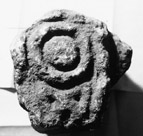
Object type: Fragment of cross-head
Measurements: H. 20 cm (7.8 in); W. 20 cm (7.8 in); D. 16 cm (6.3 in)
Stone type: Greyish orange pink (5YR 7/2), poorly sorted, clast-supported, feldspathic sandstone. The sub-angular to sub-rounded clasts vary from 0.3 to 0.8 mm, but mostly are in the range 0.4 to 0.5 mm. Millstone Grit Group, Carboniferous (C.R.B.)
Plate numbers in printed volume: Ills. 243–5
Corpus volume reference: Vol 13 p. 197
(There may be more views or larger images available for this item. Click on the thumbnail image to view.)
This stone forms part of a cross-head comprising a central boss and a short part of a cross-arm.
A (broad): This face is decorated with a protruding central boss 5.4 cm in diameter surrounded by a circular moulding. An outer moulding extends from a portion of interlace on the left to pass above and below the central boss. The interlace filled a cross-arm of which only a small portion now survives. It appears to be a two-stranded pattern terminating in a pair of V-shaped loops.
B and D (narrow): Badly damaged and broken
C (broad): This face is decorated in a similar manner to A, although only the central boss and surrounding moulding remains.
E (top): Badly weathered and worn, this appears to be the broken end of a cross-arm of which nothing now survives.
F (bottom): This face is undecorated but preserves a central protrusion.
Although fragmentary, it is clear this piece formed the centre of a cross-head and part of a cross-arm decorated with a central boss and two-stranded interlace, typical of small cross-heads in the immediate region. Examples can be found at One Ash (1 and 2), Elton Moor (1), and Leek (5) in Staffordshire; a larger version survives at Rowsley (1); in some cases these cross-heads adorned round-shafts (e.g. Ilam 2) but not exclusively. The protrusion on F may have formed a tenon used to attach the cross-head to the shaft below, but this is hard to reconstruct.
